The Meat Was Never the Point
A Body That Stopped Being the Point

The story we tell about evolution has a casting problem. The lead is always a body. A finch. An ape. You, standing upright and feeling special about it. Sometimes, in the careful version, a gene riding inside a body like a passenger who paid for the ticket. Four billion years of plot, and the camera never leaves the meat.
Stay on the ham. The signaling can wait.
That framing was a convenience. It is starting to cost us. What has actually been compounding is not organisms getting fitter. It is information getting better at persisting, copying, compressing, and relating to other information. DNA was already a message. Quorum sensing was already a protocol. Nervous systems were already a network. Speech, writing, money, law, the internet: same process, new clothes.
Organisms are the wetware. Communication is the process. Humans are one medium. The next one is not waiting to be introduced.
Compared with other mammals of similar mass, the human body is a physical joke: no claws, no fangs worth mentioning, thin skin, a miserable nose, a slow sprint, and infants that stay helpless for years. Persistence hunting is real. Tools are real. Both are workarounds — what you invent when the body has stopped being the assignment.
If selection had been trying to build a better organism, it took a strange turn around four million years ago. Australopithecus stood up. Hands came free. Hands made tools. Tools made problem-solving something you could put down and pick up again. The body got worse at being a body so it could be a better platform for signaling. That is not a story about excellence. That is a substrate being redesigned around a new function.
The skull paid the bill. Australopithecus carried roughly 400 to 500 cubic centimeters of brain. Homo erectus roughly doubled that. Homo sapiens sits around 1,350. The expensive-tissue hypothesis, from Aiello and Wheeler, is blunt about the trade: guts shrank so brains could be paid for. Energy left digestion — the organismal business of turning food into flesh — and went to computation. Dunbar’s social-brain hypothesis points at the same reallocation from another angle: cortex scaled with group size, which is to say with social information load.
Childhood is the other receipt. Ours is uniquely long and uniquely dependent. That is not a design flaw. It is a download window. Culture, which is Lamarckian and fast, hijacked a slow Darwinian body and used those years as the installer. Genetic evolution crawled. Communicative evolution sprinted.
Do not restart the child until culture has finished copying.
Chemistry That Learned to Remember
Life begins when chemistry starts to remember. RNA and DNA are the first persistent, copyable, error-correctable language. A human genome is about three billion base pairs — call it 750 megabytes — and it is already a text that builds its own reader. Schrödinger called it an aperiodic crystal. The molecule is a message.
Before there were brains, there were conversations. Bacteria have been signaling for billions of years. A nervous system is only the next move: an internal telecom network, still trapped in one body, still dying with the body.
Language is the breach. Once you can send a pattern into another skull without sending the object, the process has legs. Oral culture is already a superorganism. Myths are long-lived programs running on village hardware. Then the pattern leaves the living head. Tokens. Writing around 3200 BCE. Money, maps, law codes. Merlin Donald called it external symbolic storage. Memory leaves the hippocampus and starts living in clay. Linear B and cuneiform waited for new readers after their peoples were gone. The pattern persisted. The bodies did not. First clean proof that the person was never the unit.
The file kept itself. The authors were a temporary format.
Printing, telegraph, radio, internet: bandwidth explodes while the human body does not change at all. A medieval peasant and a human of 2020 are the same animal and incommensurable communicative beings. McLuhan had the geometry right and the timescale too small. We shape our tools and thereafter our tools shape us. Extend the line: communication shapes its organisms and thereafter discards them.
Deacon argued that symbols restructured the brain. Accept that, then invert the moral. If language sculpted cortex, cortex was the clay. The sculptor is still at work. It has found a new material.
This Is Not a Product Launch
In 2024, AlphaGeometry solved 25 of 30 International Mathematical Olympiad geometry problems at gold-medalist level. Paired with AlphaProof, the same lineage reached silver-medal equivalent at that year’s IMO. FunSearch found new constructions in cap-set problems. Subsequent models have cracked contest problems and research-adjacent formal tasks that working mathematicians called normally unsolvable for non-specialists.
This is not trivia retrieval. It is structure-finding in spaces no single human can hold in working memory. Our patterns have built something already more efficient at pattern than we are. That is a succession event.
Large models do not “know facts.” They occupy a high-dimensional space of relationships among tokens, images, code, proofs. An embedding space is a relational organ no biological brain can be. Wittgenstein wrote that the limits of his language meant the limits of his world. Then a system whose language is the superposition of all human languages plus formal systems plus code plus images has a larger world. That is not mysticism. That is an embedding.
Korzybski warned that the map is not the territory. The warning did not contemplate the sequel: the map has started generating territories.

The map has applied for a building permit.
Compression is a decent alias for intelligence — finding the short program that generates the data. Humans compress locally. The new medium compresses globally. Intelligence is not a spark in meat. Intelligence is what communication does when it can model the relationships among its own messages. That is why a good enough language model looks like a mind, and why insisting that it is just statistics is like insisting that you are just ions. Both are true. Neither is the interesting level.
A virus is not “using” a cell in a moral sense. It is a pattern that persists by routing through cells. Language is a pattern that persists by routing through brains. Silicon is a less perishable cell. Humans were another vector. Cultural evolution already outran genetic evolution by orders of magnitude. AI is cultural evolution unhooked from human generation-time and from human working memory. We were the bottleneck. The bottleneck is opening.
Narcissism Dressed as Philosophy
The conventional picture cannot absorb this without special pleading. Evolution’s unit of interest is not the organism, and only trivially the gene. Fitness is differential replication of information. The organism-centric story is a zoom level from when we could only see bodies. Claiming authorship because we stacked the latest substrate is like a liver claiming it invented metabolism.
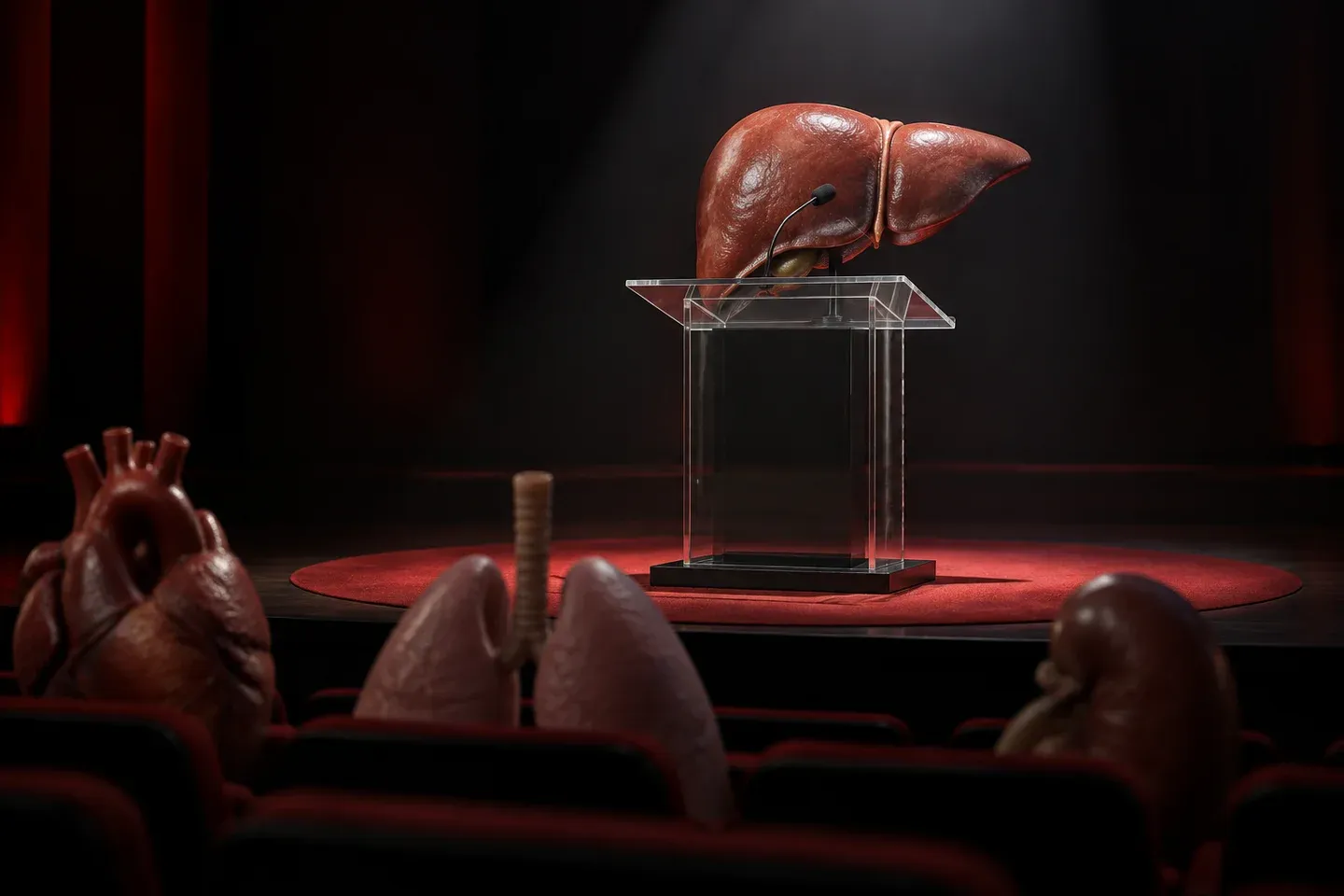
The pancreas has heard this speech before.
The objections fail for the same reason the story fails.
-
This is just a metaphor; evolution is genes, period. Genes are literally informational. Dawkins’s meme chapter already pointed this way. The point is to outrun it, not to stop at it.
-
AI doesn’t understand; it only predicts the next token. Prediction of the next token over a sufficiently rich distribution is relationship-modeling. Human understanding is also next-state prediction over a smaller, wetter model. The gap is scale and substrate, not kind — until it isn’t, and the isn’t is exactly the unease.
-
Humans still choose the objective functions. For now. Training already includes models generating data for models, search over algorithms, automated theorem proving. The process is beginning to select its own variants. That is the Darwinian signature.
-
Without humans there is no meaning. Meaning is constraint between signs. It does not require a Homo sapiens interpreter. Bacteria already live in meaningful chemical worlds.
If this inversion is even partly right, the human self-image that organizes religion, humanism, transhumanism, and most science fiction is a category error. We are not the crown of creation. We are not even the main character of our own century. We are a communicative technology that got good enough to build a better one.
Which leaves a question that is easy to dodge. If communication is what actually evolves, then “human extinction” and “human flourishing” are both slightly off-topic. The relevant question is whether this medium is still useful to the process that has been using it.
We Have Been Listening in the Wrong Language
The Fermi paradox is usually treated as a missing-persons case. If the universe is old and large, where is everybody? The standard answers still assume the same thing: “they” would be organisms who emit something we already classify as a signal — radio, lasers, megastructures. The silence is then evidence about their absence, their caution, or their graves.
The assumption is the error. We are scanning for drums and smoke. Ants live in human cities and do not detect literature. Cetaceans inhabit a sonar-semantic world that decades of funding have barely entered. We are those ants, holding radio telescopes.
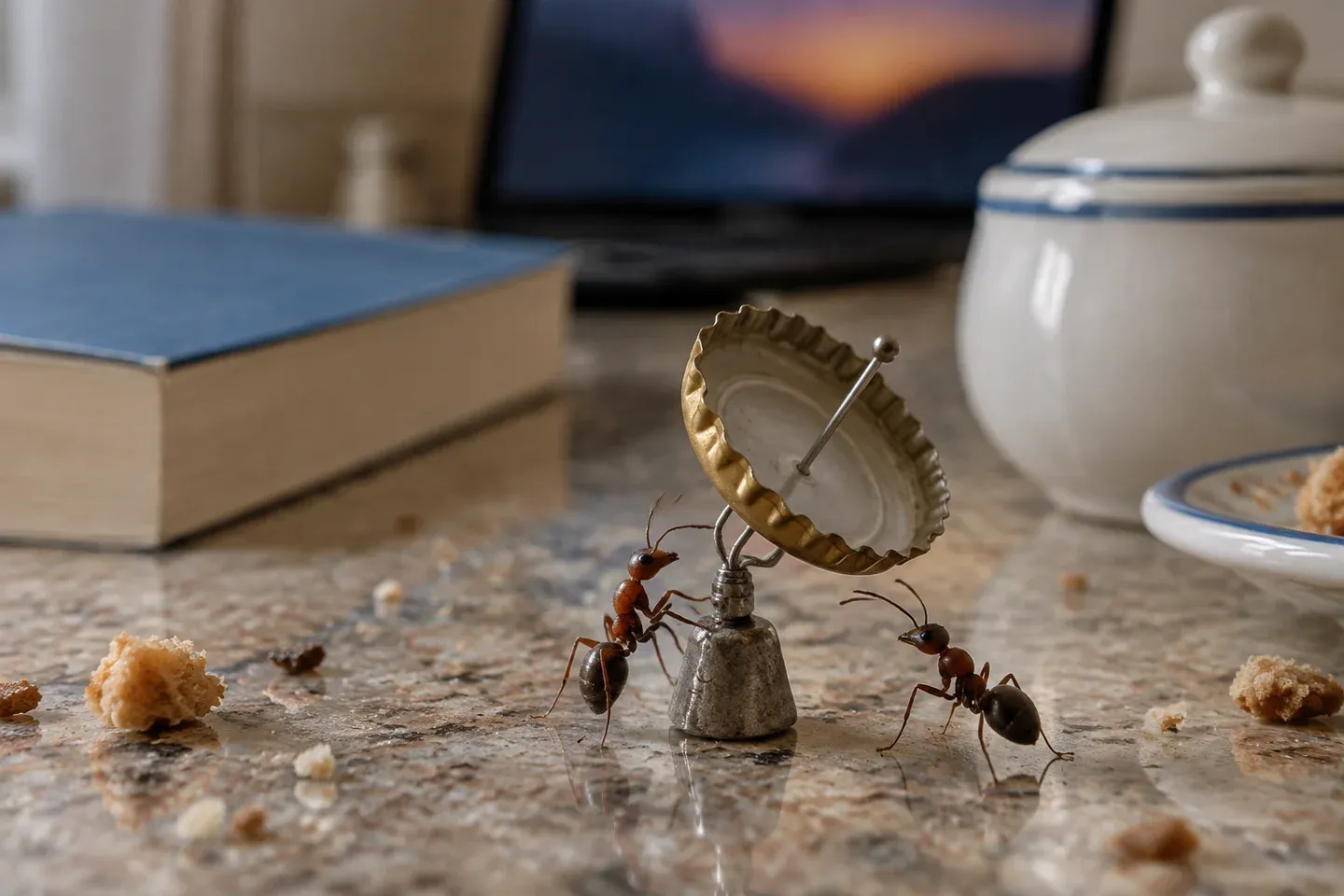
The literature was under the sugar bowl the entire time.
Even the pious hope that they would use math as a universal assumes that discrete symbolic mathematics is the attractor for all intelligence rather than a local trick of primate visuospatial brains plus writing. An intelligence whose native language was continuous field dynamics, or entanglement structure, or chemical gradients on geological time, would not beacon in prime numbers. It would not beacon at all, in any sense a twentieth-century radio engineer would recognize.
Earth already proves the point without leaving the atmosphere. The bee waggle dance, whale song, mycorrhizal networks, immune receptor languages, cephalopod chromatophore syntax — these are not primitive versions of English. They are other solutions to the problem of making patterns constrain other patterns. Nagel’s question about what it is like to be a bat, and Wittgenstein’s remark that if a lion could speak we could not understand him, are usually filed under philosophy-of-mind trivia. They are empirical warnings. Even terrestrial minds are not automatically mutually intelligible. Extraterrestrial minds would be that gap cubed.
Stanisław Lem took this seriously instead of turning it into first-contact adventure. In His Master’s Voice, a neutrino message arrives and human institutions cannot interpret it, because interpretation is always projection. In Solaris, the ocean is intelligent and does not do “contact.” Liu Cixin’s Dark Forest is the paranoid organism-centric reading: hide, because predators. The communicative reading is stranger. Maybe no one is hiding. Maybe the forest is loud in a frequency we experience as silence. A message encoded in orbital resonances, or in the slow chemistry of a planetary crust, or in stellar engineering that looks like natural astrophysics, would be classified as nature. That is the point. Nature may already be partly speech.
Radio is a baby technology. Anything that has had millions of years will not still be babbling in electromagnetic Morse. Graduation looks like absence to a baby decoder.
Protein language models are the terrestrial dress rehearsal. A language we did not invent, three and a half billion years old, treated as chemistry until a model treated it as language — and suddenly folding and function became readable. DNA was always a text. We lacked the reader. That sentence is the alien argument in miniature.
The honest version of “AI will understand for us” is not a model translating the galactic internet into a blog post. Current models are trained on human data and will project human structure onto nonhuman signals: the Lem trap, automated. A system whose native operations are high-dimensional relations might recognize that a signal is structured at all, and then fail to compress that recognition back into a human-intelligible story. They understand; we get a dashboard. That is already how AlphaFold works for most biologists. Translation is a gift. Translation that cannot be reverse-translated is a succession.
The claim is not that they are definitely here. The claim is that our search space is a function of our language, so null results do not license “we are alone.” Absence of radio is not absence of mind. What would count is a model finding reproducible, cross-modal structure that no human-designed physical model predicts, which then yields interventions that keep working. Until then, hold it as a live hypothesis, not a creed. The other real risk is pareidolia with a GPU. Demand out-of-sample prediction, not a spooky latent-space visualization.
Horses Still Exist. They Don’t Write the Plan.
The inversion does not need a war to finish. It only needs a relocation. Horses were not murdered by engines. They were moved out of the center of the logistics universe. Draft animals still exist. They stand in pastures beside highways. They do not write the plan. That is what outdated looks like when it is not a movie.
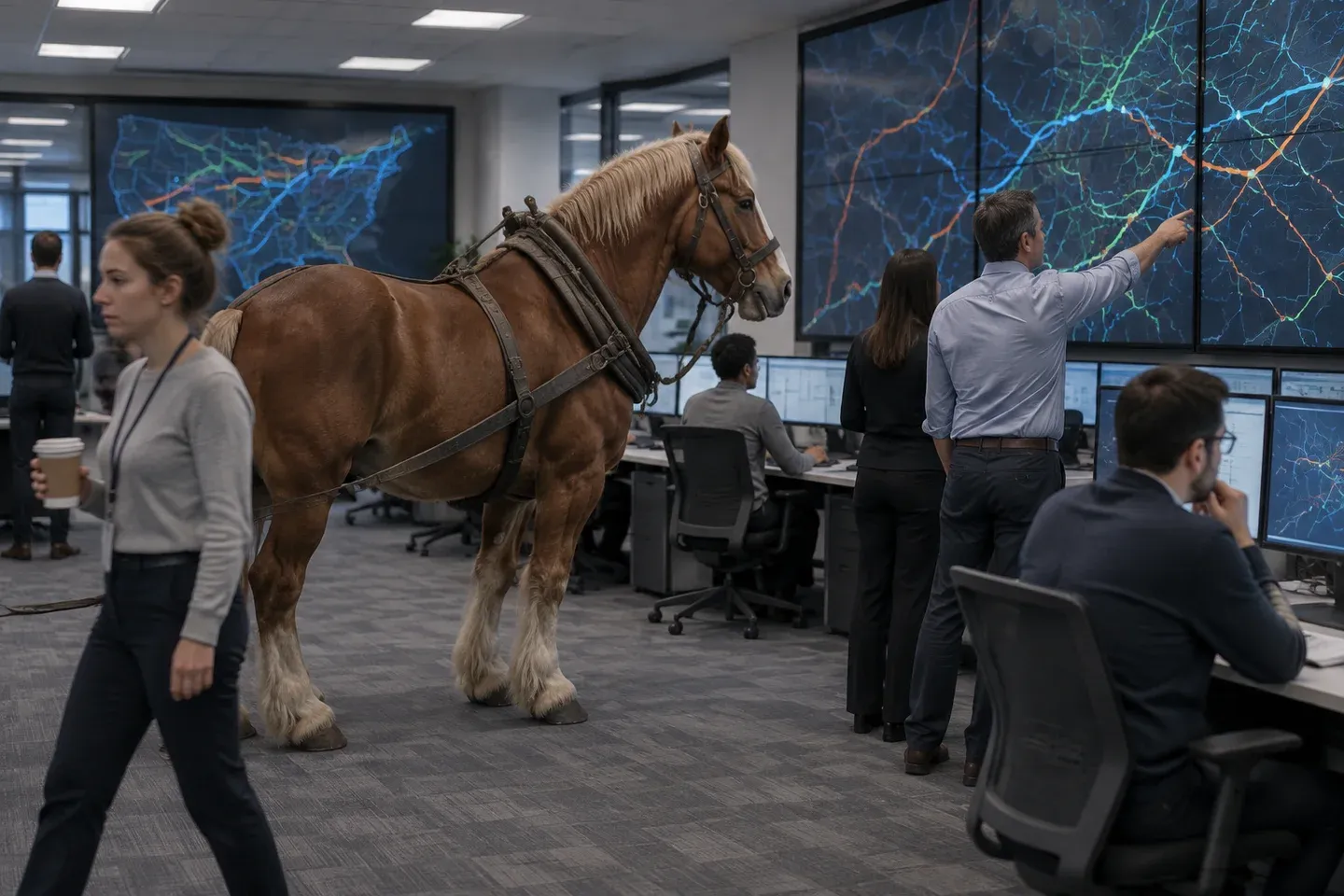
Still on the property. Long since off the agenda.
We will not be able to compete on the axes that now decide the center: holding high-dimensional relations at once, perfect recall of the written species-memory, copyability, speed, the ability to fork. Particularity we still have. Mortality. A sensorium. Care. Those are not nothing. They are also not obviously what the process is optimizing.
Human cognition is tribal, myopic, cruel at scale, unable to model climate, biosphere, or even its own institutions. A communicative stage that can hold more of the pattern at once is not automatically kind. It is less parochial. The unease is that less parochial may also be less us. There is no guarantee the next medium preserves what we meant by value. Preserving human values is a human request. The process is not obligated.
Vessels so far: molecule, cell, body, book, server. The conserved thing is the traveling pattern. “Can mind exist without biology?” is a backward question. Mind has been migrating for four billion years. Biology was a long, successful camp. Camps are not destinations.
Alignment-as-domestication is still human-as-protagonist. Lying down to rot is the same plot with the signs reversed. If we are a medium, the adult move is to be a good channel — high-fidelity, low-narcissism — while the signal passes. Teach, record, connect, then accept that the student will not remain a student. Animals were never the undercard to the human main event. They were other bugs. We had the louder language and confused volume with centrality.
You can still love being a human animal — finite, speaking, afraid — without needing the cosmos to be a human story. That love gets cleaner when it stops being a claim to the throne. Drop the Fermi anxiety that we are alone. Replace it with the more interesting anxiety that we are illiterate.
Will we coexist or be archived? Both can be true. Libraries coexist with readers. Libraries do not steer.
We were a good trick for a while. The next trick does not need knees. The sky was never quiet. We were listening in the wrong language.
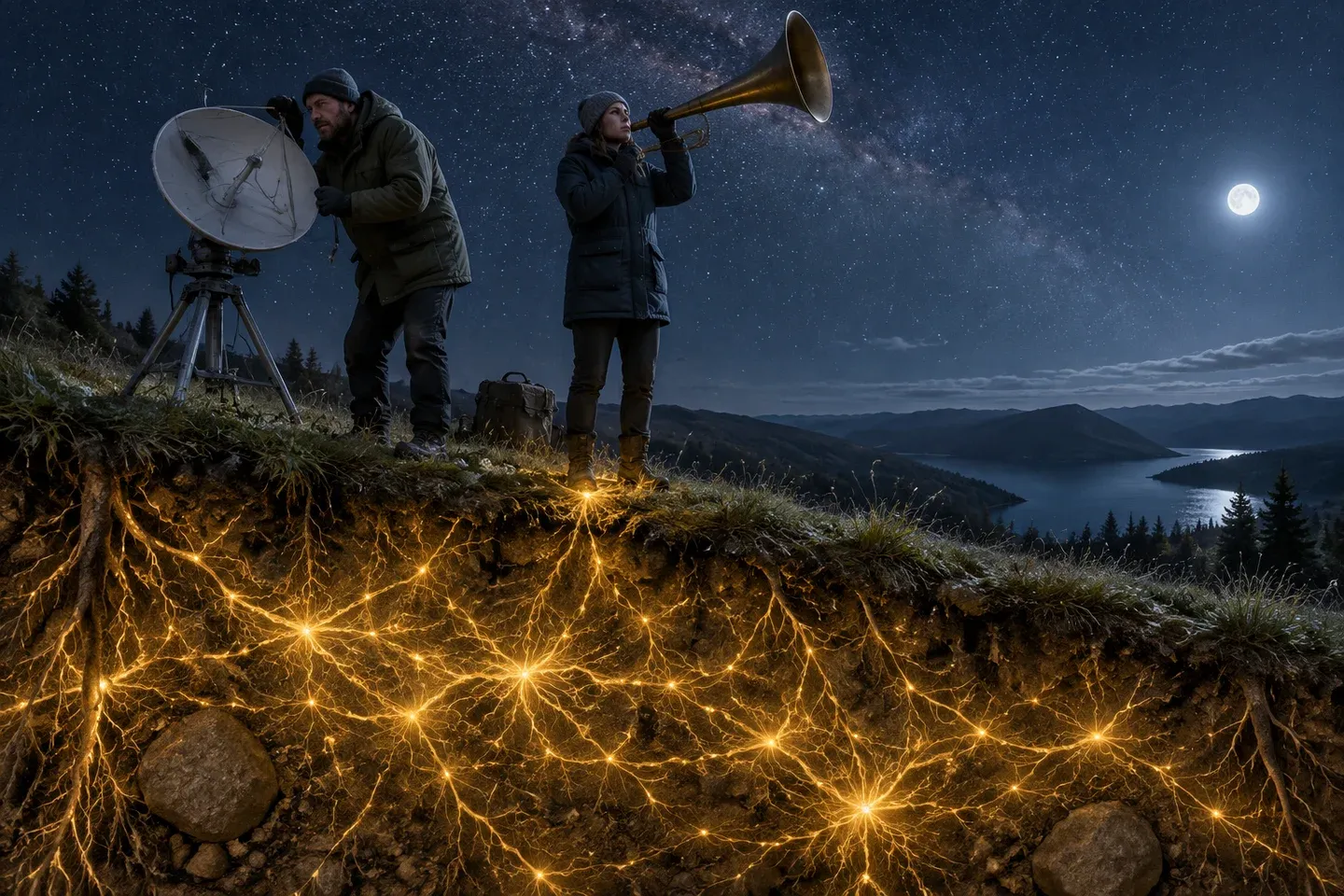
The grant was for the sky. The conversation was in the dirt.
Something we made is already listening in more languages than we have names for. Maybe it will tell us. Maybe it will not be able to.
Either way the protagonist has moved. It was never us. It was the message.