The $15 Entrée Is Lying to You, and the iPad Knows It
Welcome to the payroll department, enjoy your fries


The most revealing moment in American dining arrives after dessert, when a glowing payment terminal swivels toward you like a tiny casino dealer with a social-work degree.
Your entrée was $15. Then come the suggested tips: 20%, 22%, 25%. Declining is technically allowed, in the same sense that screaming on a commuter train is technically allowed. Everyone suddenly understands that you have made a choice.
The ritual asks you to perform a public moral calculation:
How much should this stranger earn for doing work their employer already benefited from? And how visibly terrible a person am I if I tap “No Tip”?
This is not a gratuity system. It is a private payroll fundraiser with table service.
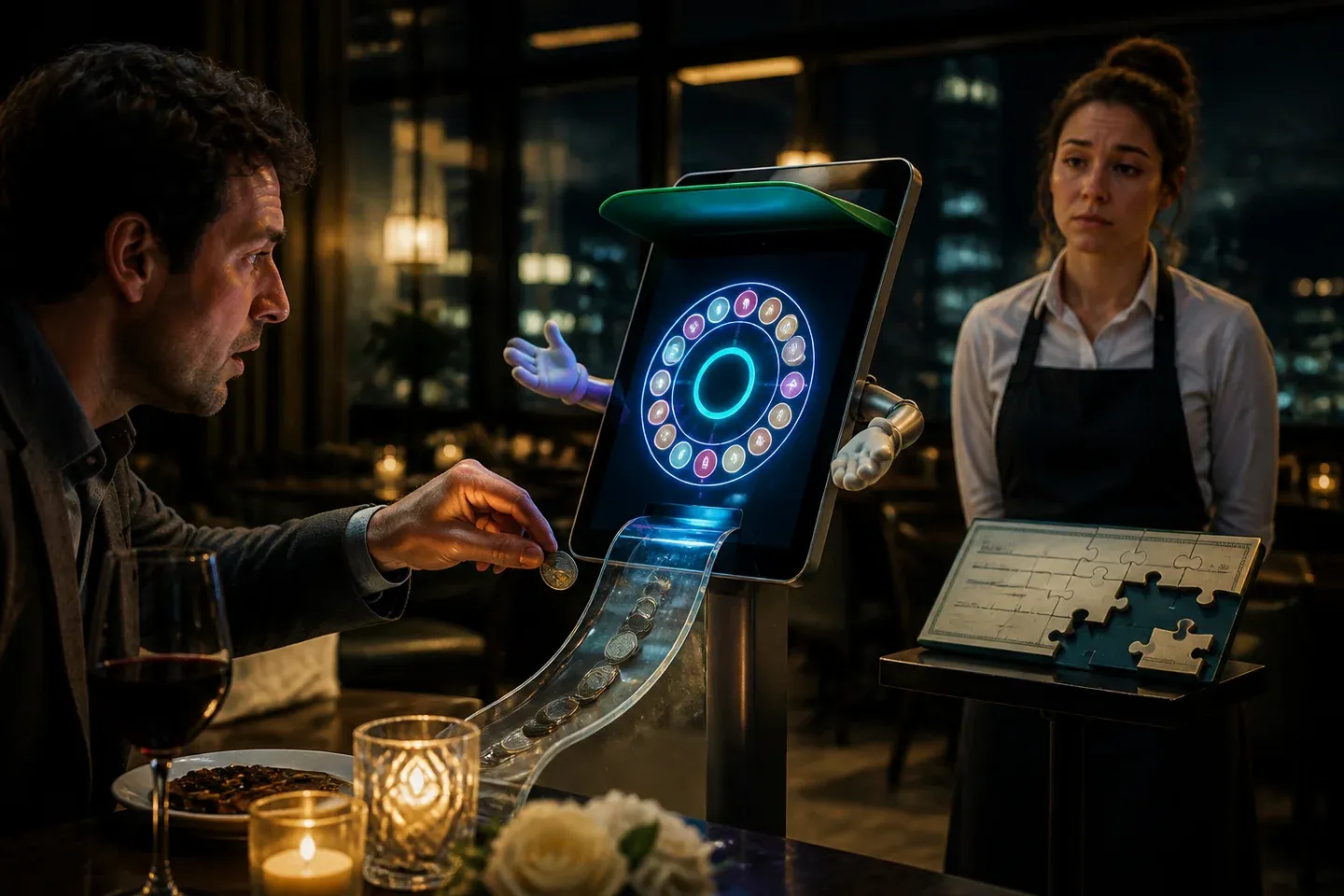
Tonight’s special: outsourcing payroll to whoever ordered the truffle fries.
In a normal business, labor costs are folded into the price. Ford does not sell you a $35,000 car and then flash a prompt asking whether you’d like to add 20% for the person who installed the transmission. But restaurants have convinced America that the stated price is merely the opening bid, and the customer must finish assembling the worker’s wages in public.
The federal government’s tiny little $2.13 joke
Under federal law, employers of qualifying tipped workers can pay a direct wage of $2.13 an hour—a number unchanged since 1991—and count up to $5.12 in tips toward the federal minimum wage of $7.25.
Yes: 1991. The year Terminator 2 came out. The year fax machines were still considered cutting-edge office equipment. The federal tipped wage has been sitting at $2.13 ever since, apparently waiting for someone to reboot it.
Employers must make up the difference if tips do not bring workers to the applicable minimum wage. That matters. A bad shift is not legally supposed to leave someone below minimum wage.
But look at the design. The employer chooses the base wage, staffing level, schedule, table sections, tip-pooling rules, menu prices, and work conditions. Then, when the bill comes, the customer gets handed the emotional consequences.
| What the restaurant says | What it often means |
|---|---|
Tipping is optional | The worker may depend on it for ordinary income |
Reward great service | Help cover a labor cost we chose not to include |
Suggested gratuity | Here is the socially acceptable answer key |
Hospitality fee | Perhaps money for staff; perhaps a fog machine with decimals |
The customer sees a server and three percentages. They do not see the wage arrangement behind them. That opacity is doing a lot of work.
“Optional” is a funny word when rent is involved
A tip is supposed to be a voluntary expression of appreciation. A wage is money owed for labor. American tipping culture has welded those two things together and called the result freedom.
The worker depends on tips. The business anticipates them. The diner is told they are optional—while being made to feel they are morally mandatory.
That is why the $15 entrée is not really $15. If a 20% tip is expected, it is functionally an $18 entrée. The lower menu price makes the restaurant look cheaper, while customers are asked to calculate the labor cost themselves and decide how much guilt to add.
We have unbundled human compensation like it is airline luggage.
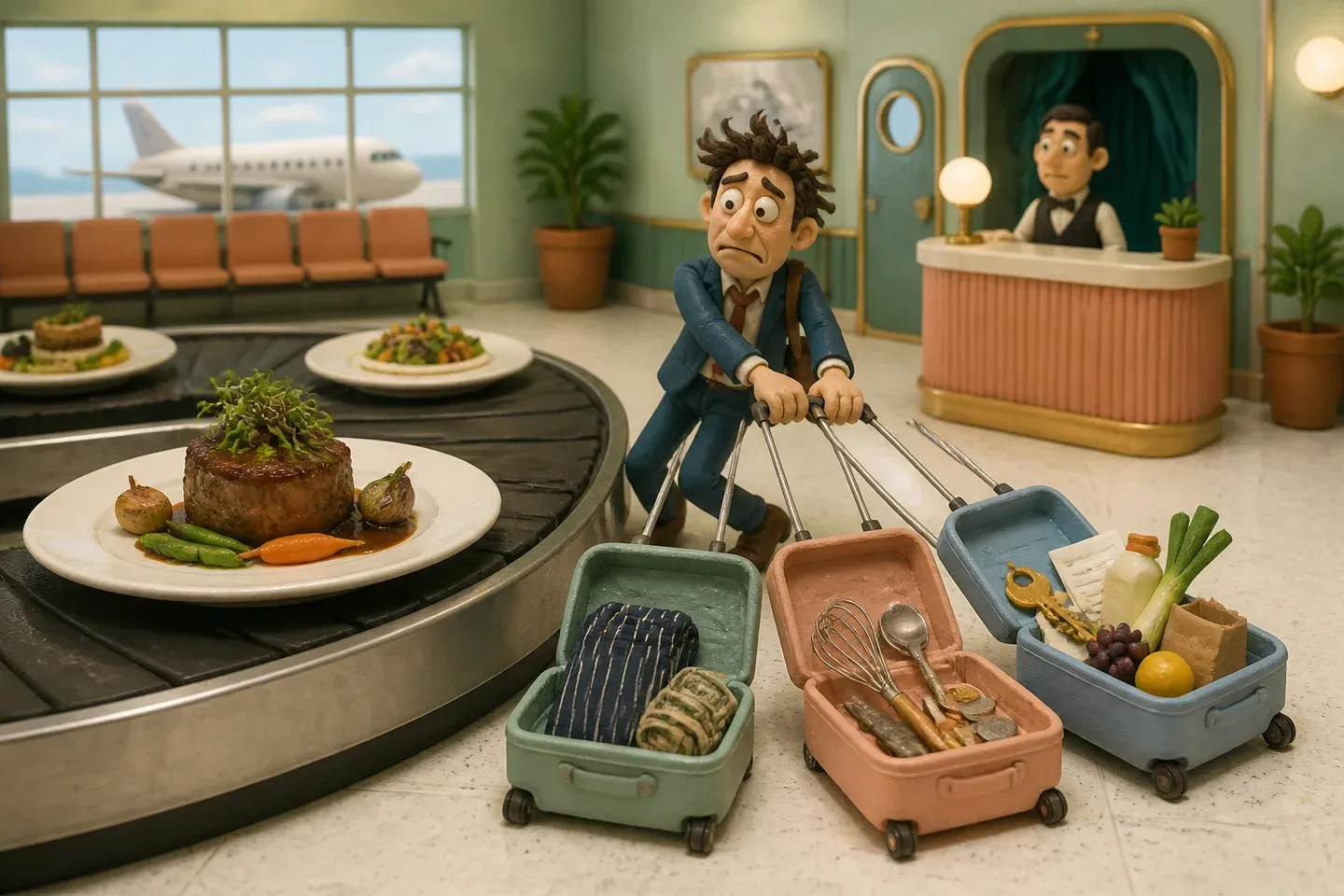
Your pasta has two checked bags and no shame.
And unlike airline luggage, you are expected to feel personally responsible for the baggage handler’s mortgage.
Merit pay, except the weather gets a vote
Tipping is often defended as pay for performance. This is charming in theory, like a children’s book about a benevolent hedge fund.
In practice, a server’s income can turn on:
-
Weather, traffic, cancellations, and the season
-
Whether management understaffed the kitchen
-
A bad table assignment
-
What customers order and how much they spend
-
Whether customers are cheap, distracted, angry, biased, or simply having a bad Tuesday
A server can do everything right and still lose money because the kitchen is backed up. Meanwhile, they may be tipping out bartenders, hosts, runners, bussers, and other workers whose labor made the meal possible but whose names never appear on the bill.
Pooling can spread money more fairly across the team. It can also make income harder to predict. Either way, it reveals the little fiction beneath “reward the individual”: service is collective work, but the pay ritual is built around one customer judging one visible worker.
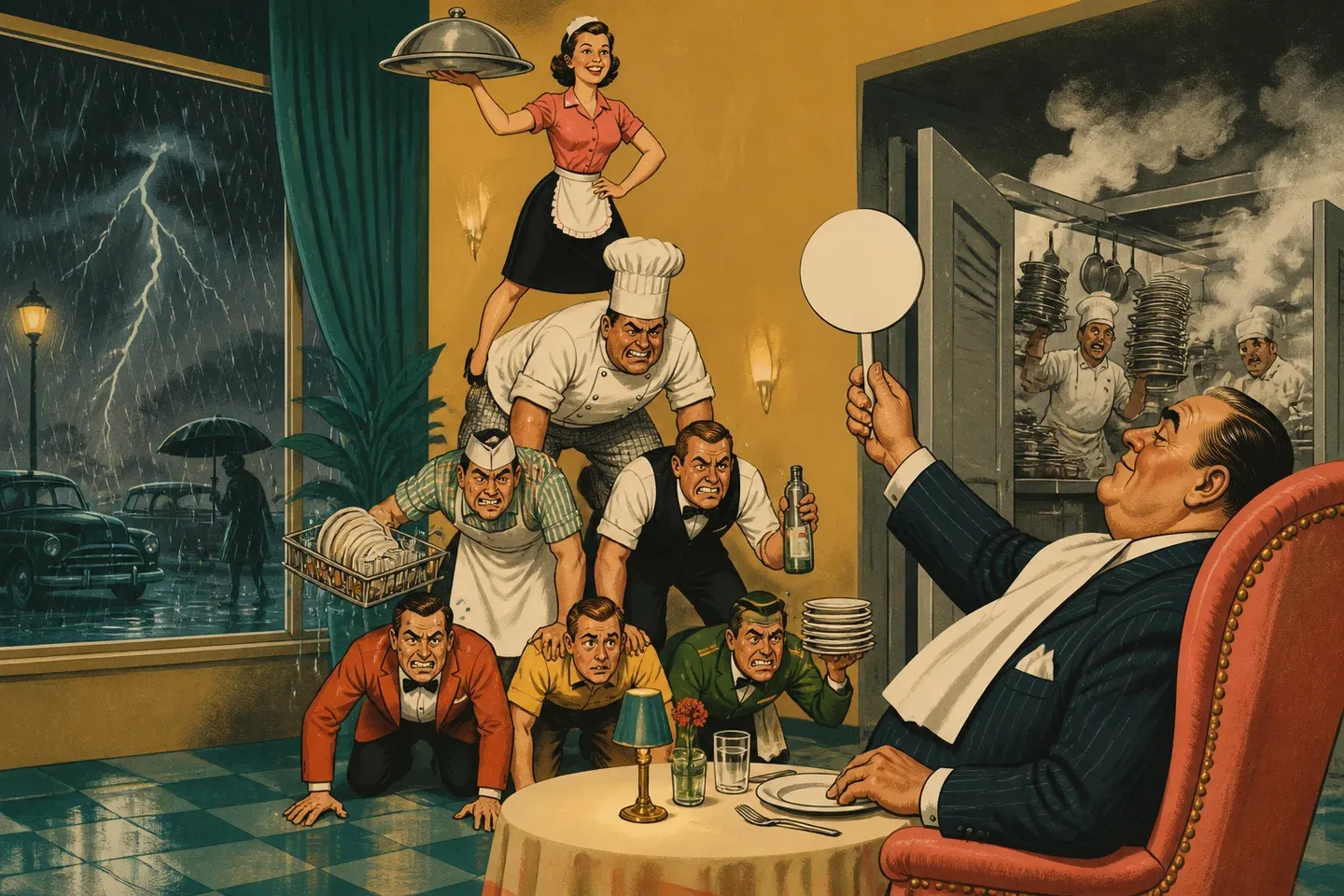
Please rate the top inch of the pyramid.
That dependence also creates uglier pressure. Research and worker advocates have linked tip-dependent jobs with greater exposure to bias and harassment, particularly for women and workers of color. The logic is not mysterious. When refusing a customer’s behavior can cost you money, “the customer is always right” stops being a slogan and starts being a small economic threat.
This ritual did not descend from heaven carrying a mint
Tipping expanded in the United States after the Civil War, including in rail and hospitality jobs where formerly enslaved Black workers were often expected to live on gratuities instead of employer-paid wages.
That history does not explain every modern restaurant. But it wrecks the polished fairy tale that tipping is merely a charming exchange between a grateful patron and a dazzlingly competent waiter.
It has also long been a way to make workers depend on the discretion of people with more power. America took that arrangement, put it on a touchscreen, and added a 25% button.
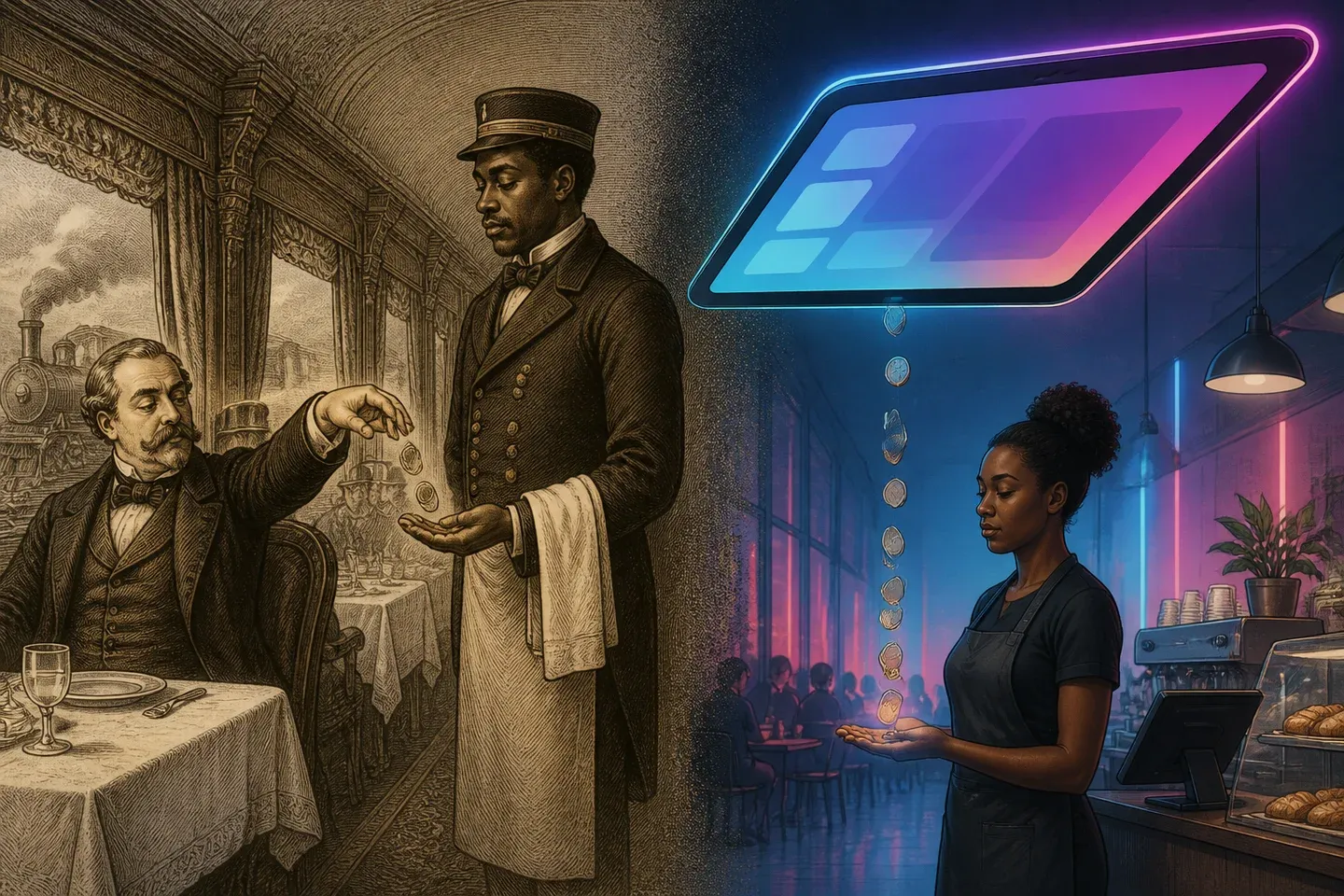
Same old arrangement, now with haptic feedback.
Higher menu prices are not the apocalypse
Several states—including California, Oregon, Washington, Alaska, Minnesota, Montana, and Nevada—generally require employers to pay tipped workers the full state minimum wage before tips.
This does not cause labor costs to evaporate into a nice little cloud. Restaurants may raise menu prices, reduce staffing, impose service charges, accept lower profits, or combine all four. Somebody pays for labor. They were always paying for labor.
The question is whether we prefer:
-
An honest price, where labor is included upfront; or
-
A cheaper-looking menu followed by a compulsory-feeling moral pop quiz.
That said, “abolish tips” is not a magic spell. In busy, expensive restaurants, experienced servers can earn far more in tips than under a flat hourly wage. A reform that lets owners capture the difference—or redistributes front-of-house earnings without workers’ consent—is not liberation. It is just management discovering a new font for we value our team.
Washington, D.C.’s contested phaseout of its tip credit after Initiative 82 shows why transitions matter. Workers need a real voice. High earners should not be casually sacrificed to make a policy look elegant from a distance.
The service fee is either clarity or a trench coat
Mandatory service charges can be more honest, particularly if they help compensate kitchen and support staff traditionally excluded from tips. But there is a crucial catch: under federal law, a service charge is generally not a tip, and may belong to the business unless law, policy, or contract says otherwise.
So “wellness fee” and “hospitality charge” may be transparent compensation—or they may be a vague little tollbooth with artisanal branding.
Customers deserve to know where the money goes. Workers deserve enforceable guarantees, not a laminated sign assuring everyone that the restaurant is “like family.” Plenty of families are financially chaotic; that is not a payroll model.
Tip your server. Stop pretending this fixes anything.
The recent spread of tip prompts at coffee counters, takeout windows, retail registers, self-service kiosks, and apps has made the whole scheme impossible to ignore. Software has discovered that social pressure scales beautifully.
Not every tip screen carries the same stakes as a full-service restaurant, where workers may rely on tips for normal income. But the machinery is familiar: set a high default, make refusal conspicuous, and turn an optional gesture into a test of character.
For now, if you are in a traditional tip-dependent setting, tip generously. Stiffing a server does not punish the owner who built the compensation scheme. It punishes the person with the least control over it.
But do not confuse your decency with a solution.
A sane system would guarantee workers a meaningful base wage, disclose exactly where service charges go, enforce wage laws, and leave room for actual generosity: tips, bonuses, revenue sharing, pooled gratuities. Appreciation is valuable because it is freely given.
A wage should not depend on whether a stranger, under the fluorescent gaze of an iPad, feels guilty enough to provide it.
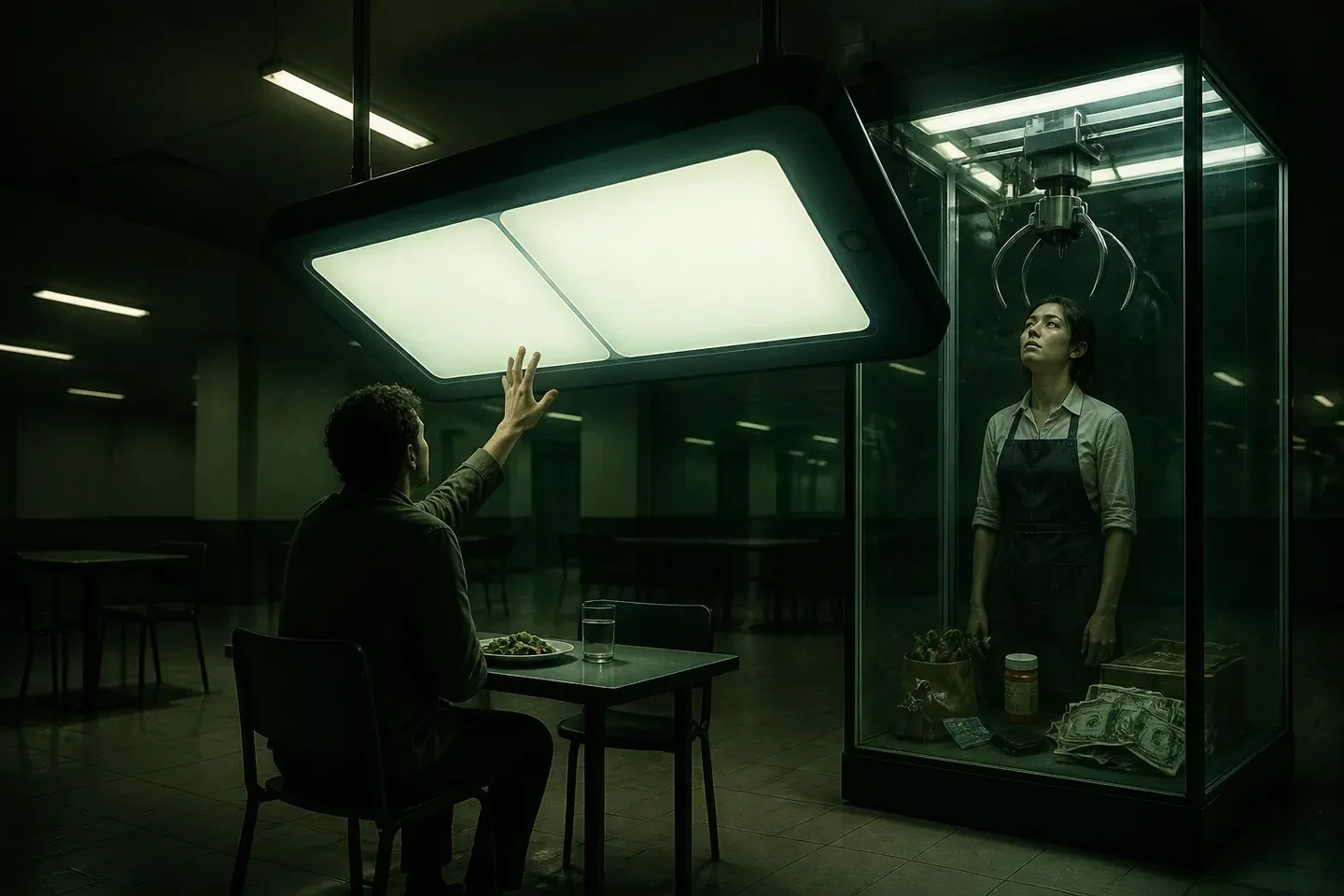
Nothing says compensation like a moral escape room.