Your Cute Little Trend Is Also Filling Out a Form
The internet’s favorite trick: making the transaction feel like a joke


“Show us your 2010 photo.”
“Use this sound.”
“Try the aging filter.”
“Tell me your diagnosis without saying it.”
Nobody sees these prompts and thinks, Ah yes, time to contribute structured material to a commercial information system. That would ruin the vibe. The vibe is: Everyone is doing this, Brenda from high school looks exactly the same, and apparently I need to prove I, too, can identify a cartoon character by my childhood trauma.
But when millions of people answer the same prompt, they do not merely make a meme. They produce a dataset with manners.
Not necessarily a secret, mustache-twirling AI plot. Not every dance challenge was invented by a man in a server room stroking a hard drive and whispering, “More ankles.” Claims that a specific trend was designed to train a specific model require actual evidence: disclosures, contracts, technical records, reporting. The fact that something could be useful does not prove somebody used it.
Still, spontaneity does not cancel extraction. A trend can start as ordinary human silliness and become valuable to a company whose business is watching, sorting, retaining, and monetizing human silliness at industrial scale.
That is the arrangement: you get a laugh, a filter, a few heart emojis from coworkers. The platform gets something much more durable.

Congratulations: your nostalgia now has a serial number.
You did not just upload a selfie. You supplied the paperwork.
The photo or video is the obvious part. The less visible part is everything wrapped around it:
-
when you posted it
-
what device you used
-
possible location information
-
hashtags, connections, and audience response
-
who watched to the end, replayed it, saved it, shared it, or swiped away in visible disgust
-
what other posts it resembles, answers, copies, duets, or stitches
A random folder of images is useful. A million images submitted to a standardized prompt—tagged, timed, linked to reactions and self-descriptions—is a collection that has already done much of the tedious sorting work for you.
| The harmless-looking trend | What it can standardize |
|---|---|
| “Then versus now” | Paired images of the same person at different life stages |
| A shared routine video | Homes, objects, clothing, recurring activities, environments |
| A product challenge | An item, a reaction, a style preference, audience response |
| “Repeat after me” audio | Many voices against the same known script, with different accents and pacing |
| Confession or quiz templates | Health details, relationships, work history, political attitudes, anxieties, slang |
The point is not that every platform feeds every scrap into a generative AI model. That is the kind of sloppy claim companies enjoy, because they can knock it down and stroll away looking innocent.
The point is more annoying: people are constantly teaching systems what they notice, prefer, fear, buy, replay, reject, and imitate.
A long watch says something. A quick swipe says something else. A save says, “This may matter later.” A share says, “This may matter socially.” A report says, “Perhaps investigate this chaos goblin.”
You are not filling out a survey. You are providing the survey’s answer key with your thumbs.
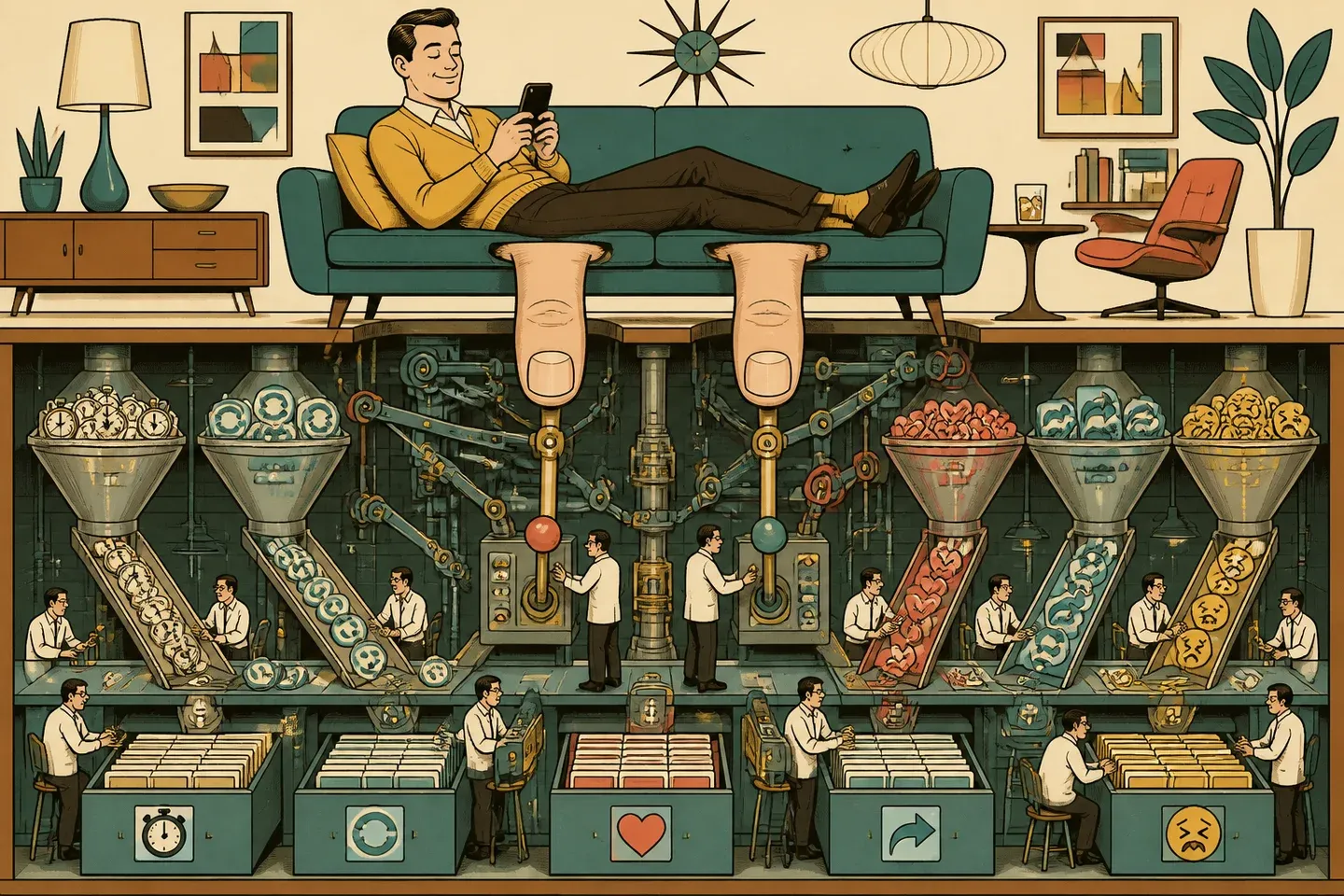
The customer feedback form has learned to clap.
“AI” is the perfect fog machine
The phrase “this trains AI” now gets applied to everything from a chatbot prompt to a person blinking near a Wi-Fi router. It is usually doing the work that precision refuses to do.
Platforms have long used behavior to rank posts, target advertising, test features, and identify safety problems. Those uses are not identical to training a broader generative model, even if the same material could be relevant to both. Depending on the company’s policies, content and feedback may also be used for AI evaluation or improvement. Or not. Product, region, settings, and terms matter.
That distinction is not a favor to the companies. It is how you keep the real concern from being buried beneath an easy-to-debunk panic.
Service improvementis one of the great phrases of modern commerce: broad enough to sound helpful, vague enough to conceal a small airport.

Nothing says reassurance like a privacy policy with runway clearance.
In 2024, Meta said it would use publicly shared adult content on Facebook and Instagram in certain regions to develop and improve AI at Meta. That drew regulatory attention in Europe over legal basis and opt-out questions. Which gets to the unpleasantly ordinary heart of the issue: data collected to keep you scrolling can gain new value years later because the technology changed.
You posted a beach photo for your cousins. The platform may see a public input to a system whose future uses were not even fashionable when you uploaded it. Progress: the old bargain, now with better branding.
Filters are not automatically face-recognition traps. They are still not nothing.
The 2019 FaceApp panic was a useful mess. Viral aging photos triggered fears about ownership, retention, and facial recognition. Some of the most dramatic claims did not hold up.
But the public had stumbled into a real question before sprinting past it in a bathrobe: where does your face go when a novelty app asks for it, and what happens there?
An effect that changes your age, tracks your hand, applies makeup, or fits a mask to your face may use face landmarks, head position, expression, pose, camera information, or interaction data. That does not automatically mean it creates a portable biometric profile or a facial-recognition database. Legal definitions can turn on whether a system makes a template or scan used to identify someone. Some processing may happen largely on the device; other features may involve cloud processing, analytics, or remote servers.
The correct response is neither “It’s stealing your face!” nor “Relax, it’s just a filter.”
It is: show people the architecture before they hand over the raw material.

If it’s just a filter, the plumbing should be allowed to exist.
Selfie-avatar apps make the bargain even less subtle. They may request 10, 20, or more photos in different lighting, angles, expressions, and styles to generate convincing personalized portraits. Fair enough: a system cannot produce a plausible version of your face from one dim photo taken in a bar bathroom.
But “we need these images to make your avatar” does not settle:
-
Whether they are processed on your phone or uploaded.
-
How long they are retained.
-
Whether you can delete them.
-
Whether inputs or outputs improve the provider’s systems.
-
Whether affiliates, vendors, or subprocessors receive them.
-
Whether everyone else in those photos agreed to be part of your little cyber-Renaissance.
A service can need your pictures for Tuesday’s cartoon headshot without earning indefinite rights to reuse them forever. These are separate questions. They are routinely treated as one because reading terms of service feels like being slowly buried in wet legal mulch.
Your private overshare has excellent formatting
Faces get the headlines. Text is often the richer haul.
A confession template, personality quiz, comment bait, or AI chat exchange can turn private experience into clean, machine-readable language: your fears, work problems, relationship dynamics, health information, ambitions, tastes, politics, and preferred flavor of self-deception.
And then the system can connect that language to an account, response patterns, declared or inferred demographics, social connections, and the reactions your post draws. Congratulations: your emotional crisis has engagement analytics.

Your breakthrough has been assigned a retention curve.
AI chat tools make this especially direct. Prompts and feedback may be logged to provide the service, prevent abuse, personalize results, evaluate quality, or improve products. But consumer tools, enterprise plans, and API services do not necessarily have the same terms. It is inaccurate to declare that every query trains a general model.
Even where broad model training is not happening, the interaction is revealing:
-
the follow-up question shows what answer you wanted
-
the rewrite shows what the system got wrong
-
the thumbs-up shows what seemed useful
-
the abandoned conversation shows where it lost you
That is not sinister by itself. It is how products improve. It becomes a problem when the exchange is disguised as magic, therapy, homework help, companionship, or a free personality generator—and the data policy is left in the basement behind a filing cabinet marked “We Value Your Privacy.”
The platform guards the vault because the vault is the business
People often imagine social platforms simply selling every post to outside AI companies like a flea market vendor unloading old DVDs. The more immediate beneficiary is usually the platform itself.
It can use content and behavioral feedback for hosting, ranking, advertising, safety, product development, and internal analysis. Depending on the rules and arrangements, access may extend to affiliated AI teams, contracted processors, annotators, researchers, developers, or advertisers using trend and targeting tools.
This creates one of the more honest hypocrisies in tech:
Unauthorized scraping is theft. Authorized internal analysis is innovation.

Same gold, different lanyard.
Sometimes blocking scraping protects users, infrastructure, and legal compliance. Fair enough. But it also protects the platform’s commercial asset: the enormous, constantly refreshed record of what people make, say, watch, and reveal.
Users are often told they retain ownership of their posts while granting broad licenses to host, distribute, modify, analyze, and improve the service. In practice, “you own it” can mean you own the charming little shovel while somebody else controls the mine.
And deletion is not a magic eraser. Removing a post may stop future availability in one place, but it may not be technically feasible to remove its effects from backups, analytical systems, compiled datasets, or a model already trained. That does not mean everything lives forever everywhere. It means consent matters most before the material enters machinery designed not to forget.
Nobody needs a wage for every dance. They need to know the deal.
The answer is not to invoice TikTok every time someone does a shoulder move in their kitchen. People get genuine things from these platforms: entertainment, creative tools, community, distribution, sometimes income. Turning every human trace into a paid commodity could create a fresh layer of surveillance with a receipt attached.
But payment is not the only measure of fairness. The basic requirement is an intelligible exchange.
If an app wants sensitive material—faces, voices, private text, children’s images, high-resolution photos—it should explain, at the point of use:
-
whether processing is on-device or in the cloud
-
how long material is kept
-
what categories of data are involved
-
whether inputs or outputs improve models
-
who receives the material
-
whether deletion and meaningful opt-outs exist
Not in a policy written for lawyers and discovered only after someone posts a thirty-part panic thread at 2 a.m.
People can reduce some risk: check third-party viral apps rather than assuming the host platform’s rules apply; review sharing and model-improvement settings; revoke old app connections; treat distinctive voice clips, addresses, private documents, children, and other people’s faces with more care than a dancing potato filter deserves.
But that is harm reduction, not a solution. Ordinary people cannot be expected to perform a miniature data-governance audit every time the internet says, “Come on, it’ll be funny.”
Because it often is funny. That is why this works.
A trend can be a joke, a ritual, a creative act, and a structured contribution to commercial infrastructure all at once. The unsettling part is not a secret cabal inventing dances to harvest faces. It is the far more durable arrangement in which play has become one of the cheapest, happiest, most scalable ways to collect information.

The harvest festival got an update.
The least we can demand is to see the bargain before the joke outlives us.