AI Slop Is Real. So Is the Human Slop We Pretend Was Art.
Before the chatbot, there was already a landfill


“AI slop” is a terrific insult. It has texture. It sounds like something ladled from a gray cafeteria vat by a machine that has never known hunger, shame, or a deadline.
And there is plenty of it: glossy nonsense illustrations, fake expertise in a calm cardigan voice, recycled advice, engagement bait dressed as insight, songs that sound like a shampoo commercial undergoing a minor spiritual awakening.
But the phrase comes with a flattering little lie: that the opposite of slop is human-made work.
Please. Humanity invented slop. We practically put it on the flag.
Long before generative AI arrived to make every LinkedIn post sound like a hostage statement from a management consultant, people had built an industrial slop economy:
-
content-farm listicles
-
scam scripts
-
corporate slide decks engineered to erase the will to live
-
plagiarism
-
propaganda
-
spam
-
stock-photo clichés
-
motivational graphics with sunsets and fonts that should require a permit
Human beings have always been capable of producing work that is derivative, manipulative, ugly, false, or simply so bland it leaves no evidence of having passed through the mind.
What AI changed was not the existence of cultural garbage. It changed the production cost. Now the garbage can arrive faster, cheaper, more polished, and in quantities previously available only to mold, mosquitoes, and corporate email.
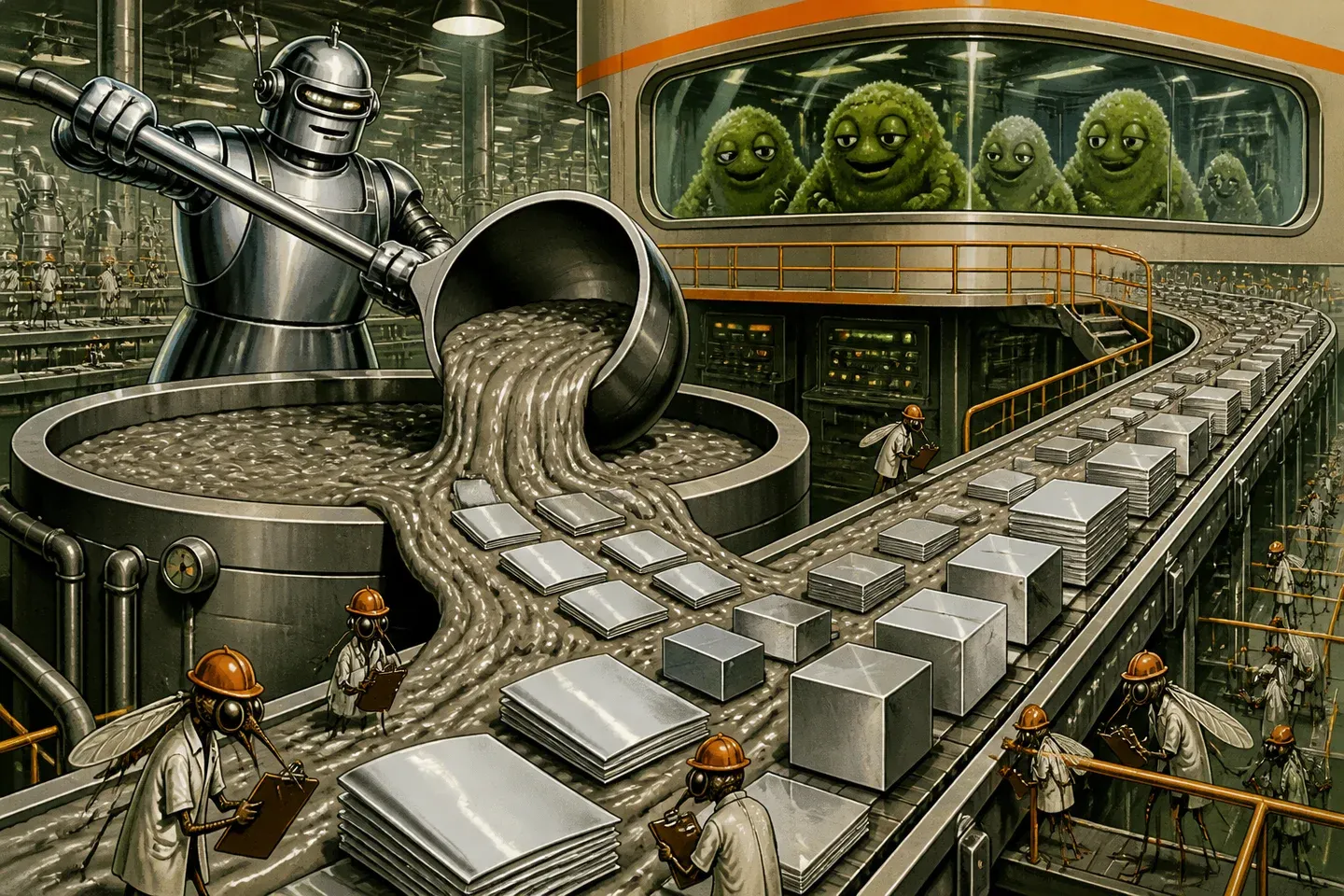
At last, scale has found its least deserving achievement.
That matters, especially for people whose work is suddenly easier to imitate: writers, illustrators, translators, researchers, coders, tutors, designers. These were not just jobs. They were evidence that somebody had spent years learning to notice things, make choices, develop taste, and be wrong in increasingly sophisticated ways.
Now a system can produce a passable first draft of many of those tasks before the coffee has cooled.
The threat is not merely “will this cut wages?” though yes, obviously, it may. The threat is also that the culture may decide passable is plenty—which is how you end up with a society run by the intellectual equivalent of airport carpeting.
The machine is not the crime scene
The useful question is not: Was this made by a machine?
The useful question is: What, exactly, did this do?
| Approved panic | The question that actually matters |
|---|---|
| “It’s AI!” | Is it false, repetitive, or deceptive? |
| “It copied an artist’s style!” | Was work used without consent? Is it impersonating a living creator? |
| “It looks professional!” | Is it accurate, or merely fluent enough to escape scrutiny? |
| “It can do the job faster!” | Whose job, pay, bargaining power, and credit just got converted into “efficiency”? |
| “Nobody can tell!” | Was disclosure necessary for trust, compensation, or a fair evaluation? |
A clean image can be empty. A coherent paragraph can be wrong. A technically accomplished song can still have all the emotional nourishment of a supermarket jingle.
Likewise, a human’s “imperfections” are not automatically profound. A broken note can reveal a body, a history, a person taking a risk. An invented fact is not a brave artistic choice. An unreadable interface is not soulful. A racist stereotype is not evidence of authentic human roughness.
Human origin is not a quality-control stamp. It is a fact about origin.
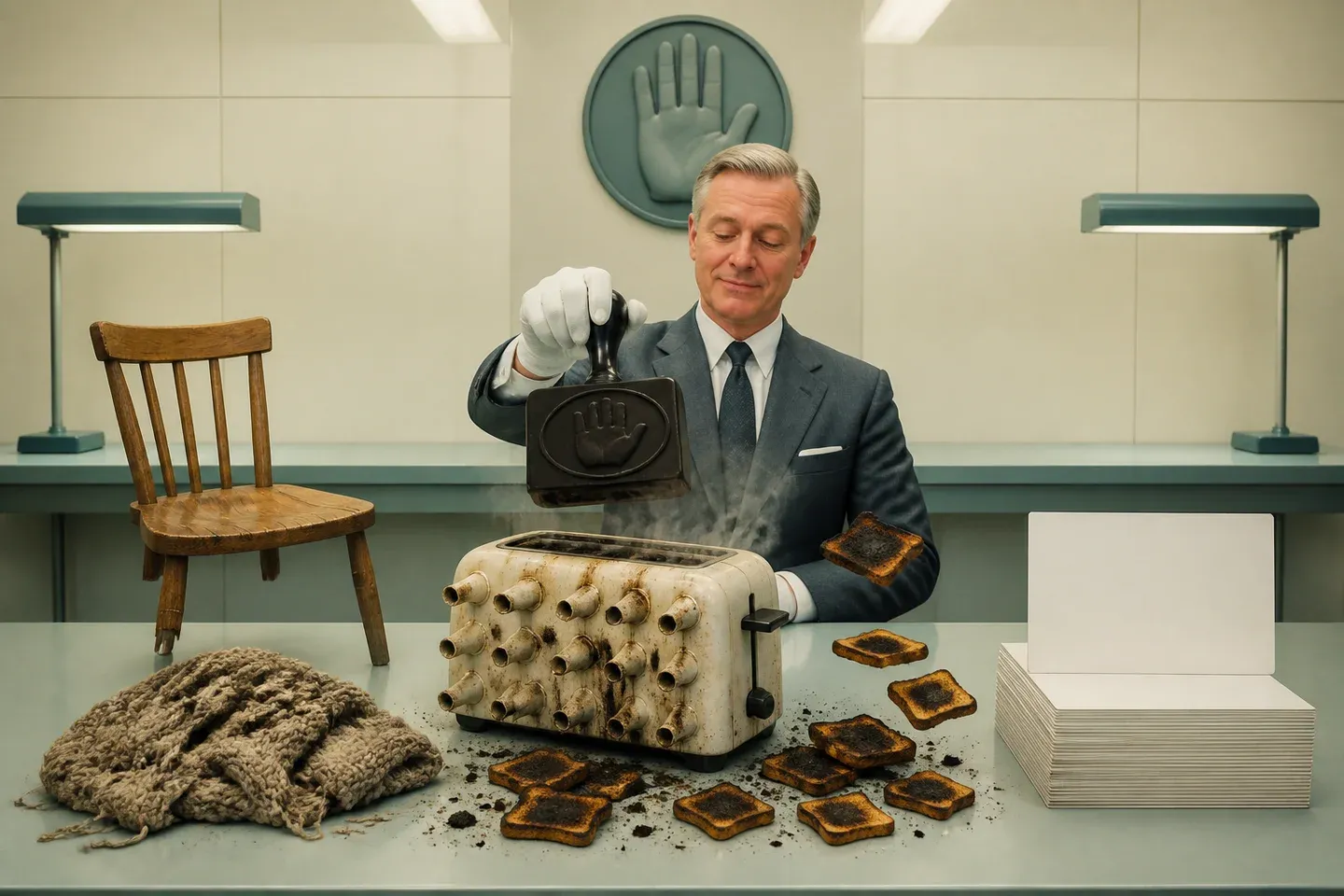
Handcrafted, like salmonella.
The stronger objections to generative AI are usually not aesthetic. They are about consent, compensation, disclosure, and power: whether systems were trained on work collected without permission; whether they imitate living artists; whether publishers conceal substantial machine involvement; whether companies are turning creative workers into unpaid raw material and sending the financial reward upstairs to platforms and investors.
Those are not precious questions of artistic purity. They are labor questions. They have invoices.
“But it hallucinates” is not a human rights argument
AI systems can confidently invent citations, court cases, product features, facts, explanations—little counterfeit nuggets of certainty. In medicine, law, journalism, finance, and public services, this is not a charming quirk. It is a dangerous defect wearing a tie.
Generative systems predict plausible continuations. They do not possess an inner obligation to truth. They often answer when they should say, “I don’t know,” which is also the official motto of half the internet.
But humans do not get to stand nearby in a white robe, glowing with epistemic purity.
People misremember. They repeat claims whose source has evaporated. They mistake familiarity for truth. An idea heard in an ad, echoed by family, reinforced online, and repeated at dinner can become “something everybody knows.”
Fluent certainty is not wisdom, whether it comes from a chatbot or a man explaining currency at a barbecue.
The comparison is not flawed machines versus flawless people. It is between different systems of error and correction.
AI can sometimes be benchmarked, logged, rerun, constrained, checked against retrieved sources, monitored, patched. That is an engineering advantage—not proof of trustworthiness. These systems can fail outside their testing conditions, replicate mistakes at astonishing scale, and be optimized for speed, engagement, or market share rather than accuracy.
Still, nobody can version-control your uncle’s political memory or issue a patch for a manager’s prejudice.

No update available. Have you tried turning the barbecue off?
The answer is calibrated trust: require sources, verify consequential claims, use expert judgment, audit systems that affect safety, rights, livelihoods, or public knowledge. In other words, stop treating a smooth answer as proof that anyone—human or machine—did their homework.
The AI detector is a lie detector for people who enjoy accusing strangers
The frantic hunt for machine-made work has produced its own pathetic little ritual: forensic guessing.
Text detectors look for statistical patterns. They generate false positives and false negatives. Editing, paraphrasing, translation, or changing model settings can undermine them. Formulaic human prose and non-native English writers can be especially vulnerable to suspicion, because apparently being a little too grammatical is now evidence.
OpenAI withdrew its own AI Text Classifier in 2023 because of low accuracy. A company that built the stuff took one look at its detector and said, essentially, actually, never mind.
Visual tells—extra fingers, strange lettering, melted anatomy—were always hints, not proof. Human artists draw awkward hands. Generated images can be retouched. Metadata can disappear.
The result is a culture where artists with unfamiliar styles become suspects and writers are asked to provide alibis for every semicolon. This does not protect creativity. It turns authorship into a purity test while the actual economic machinery keeps humming underneath.
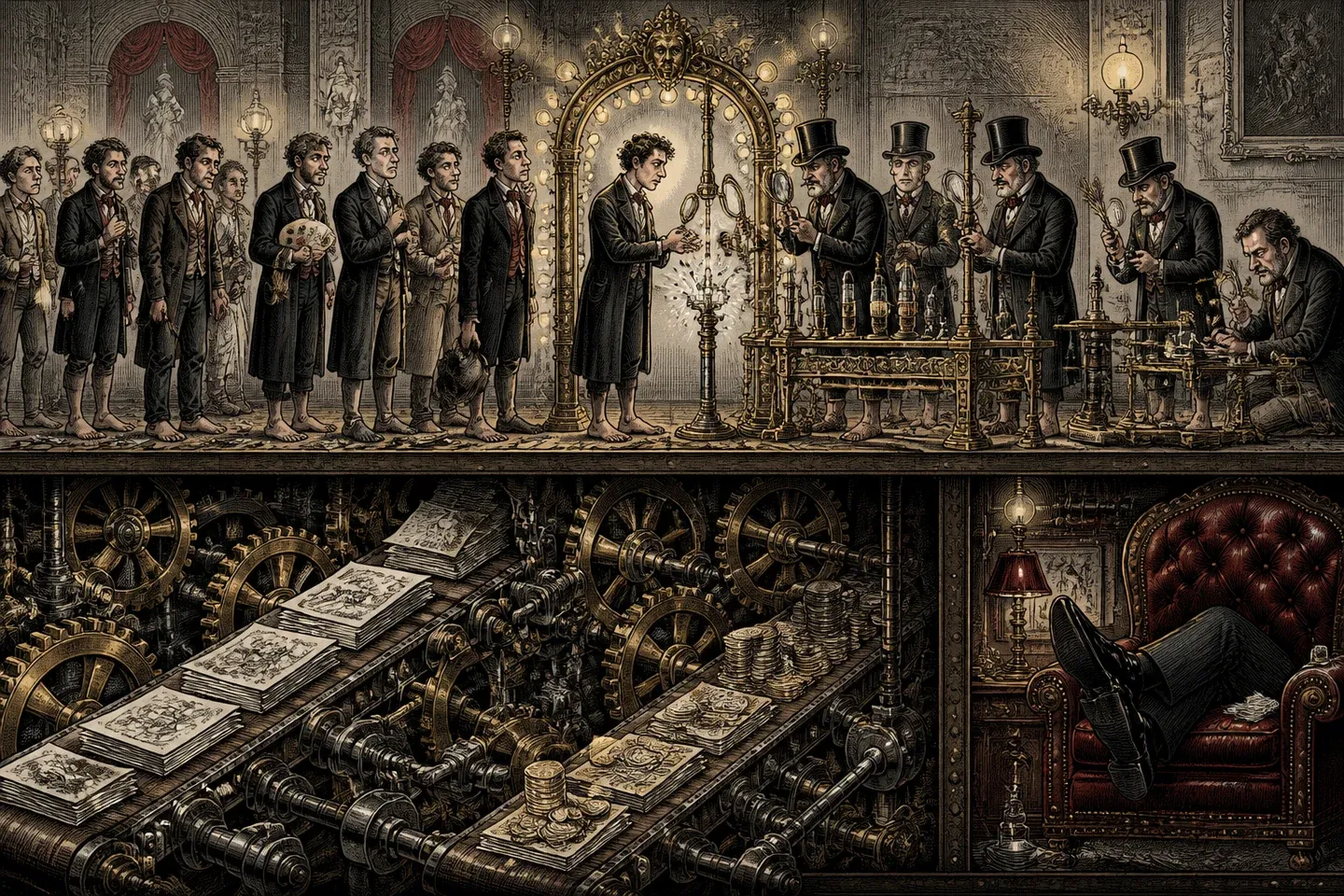
Meanwhile, the money tunnel remains open.
Provenance tools such as C2PA Content Credentials may help document a work’s editing history when creators, platforms, and tools adopt them. Fine. A newsroom, classroom, contest, commercial commission, or professional assessment can reasonably set rules in advance and require disclosure.
But provenance cannot answer whether something is beautiful, exploitative, useful, honest, or worth your time. It is a receipt, not a soul detector.
The real nightmare is not machine talent. It’s executive imagination.
The technology itself is not mystical. Modern systems emerged from a convergence of transformer architectures—helped along by the 2017 paper “Attention Is All You Need”—huge datasets, specialized hardware, distributed computing, and mountains of investment. More model capacity, data, and training compute often improved performance together.
That trajectory has limits: energy costs, hardware supply, bad data, reliability, planning, real-world brittleness. But the social threshold may already be here. These tools can draft code, summarize documents, translate, generate training materials, assist research, design, and distribute cognitive work at costs that once would have been prohibitive.
Which means institutions are not waiting for philosophical clarity. They are asking: Can we replace five paid people with one exhausted person checking a machine’s output?
That is the question hiding inside much of the AI debate.
A society that lets artists, translators, writers, and knowledge workers become disposable inputs has not discovered a law of nature. It has made a political choice, then put the choice in a hoodie and called it innovation.
The response should be just as concrete:
-
Compensation and licensing where work is used.
-
Clear contracts and disclosure rules.
-
Labor protections against displacement disguised as convenience.
-
Attribution where attribution is owed.
-
Accountability for the companies that build and deploy these systems.
-
Public investment in art, education, and the human capacity that markets love to praise right up until the invoice arrives.
Human beings remain necessary not because we have souls that pass a CAPTCHA test, but because someone must decide what is worth doing, whose consent matters, which harms count, how gains are shared, and when a system should not be used at all.
If a work helped, informed, or moved someone until its provenance was revealed, that revelation may say less about the work than about the status hierarchy the audience was using to judge it.
Humanity is not a synonym for quality. But neither should humanity be reduced to free training data, cheap supervision, and an apologetic bystander role in its own culture.
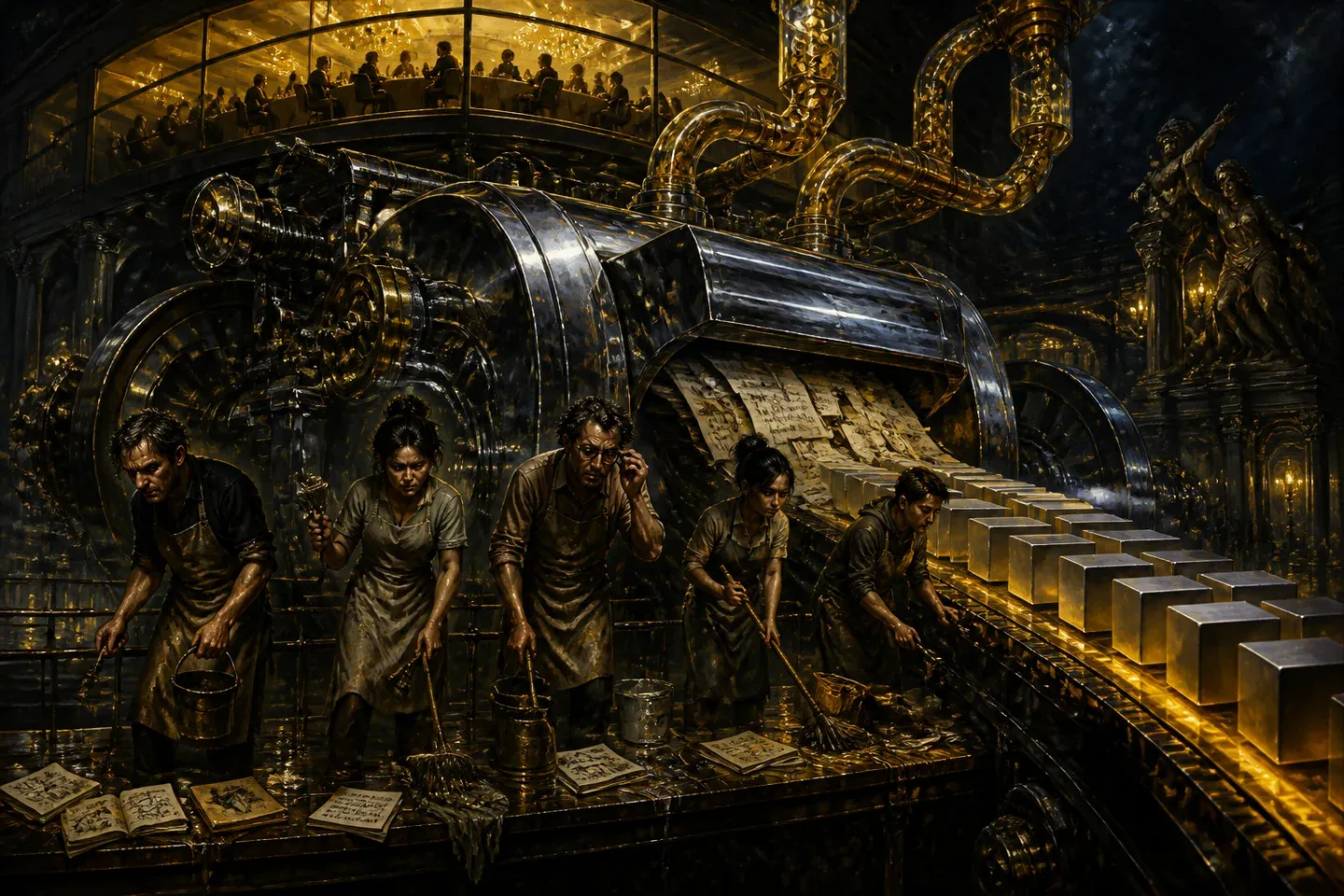
Please remain available to clean up after your replacement.