Retirement Is the Prize for Surviving the Years You Were Supposed to Enjoy
Retirement Was Built — and Then Turned Into a Farewell Party


Retirement is sold as the grand reward for behaving yourself through adulthood: endure the commute, the performance reviews, the “quick sync” that eats lunch, the relocations, the unpaid emotional labor of pretending Sharon’s spreadsheet is interesting — and eventually, at 67 or whenever the actuarial goblins approve it, your time will finally be yours.
There will be beaches. Golf. Long weekday lunches. Maybe Tuscany, if the 401(k) portal and your left hip agree.
It is an odd deal when you say it out loud. We spend our strongest years trading time, health, attention, and sometimes cartilage for the right to enjoy life later, when our knees, eyesight, energy, family responsibilities, and ability to sleep in a hotel bed designed by sadists may have other plans.
Retirement itself is not the scam. The right to stop working without becoming poor is one of civilization’s better inventions. Nobody who spent 40 years lifting, cleaning, nursing, driving, building, stocking, or absorbing abuse from customers should have to keep clocking in until their body submits a resignation letter.
The scam is the sequence:
Give us nearly all of adulthood, and we will permit you to become a person afterward.
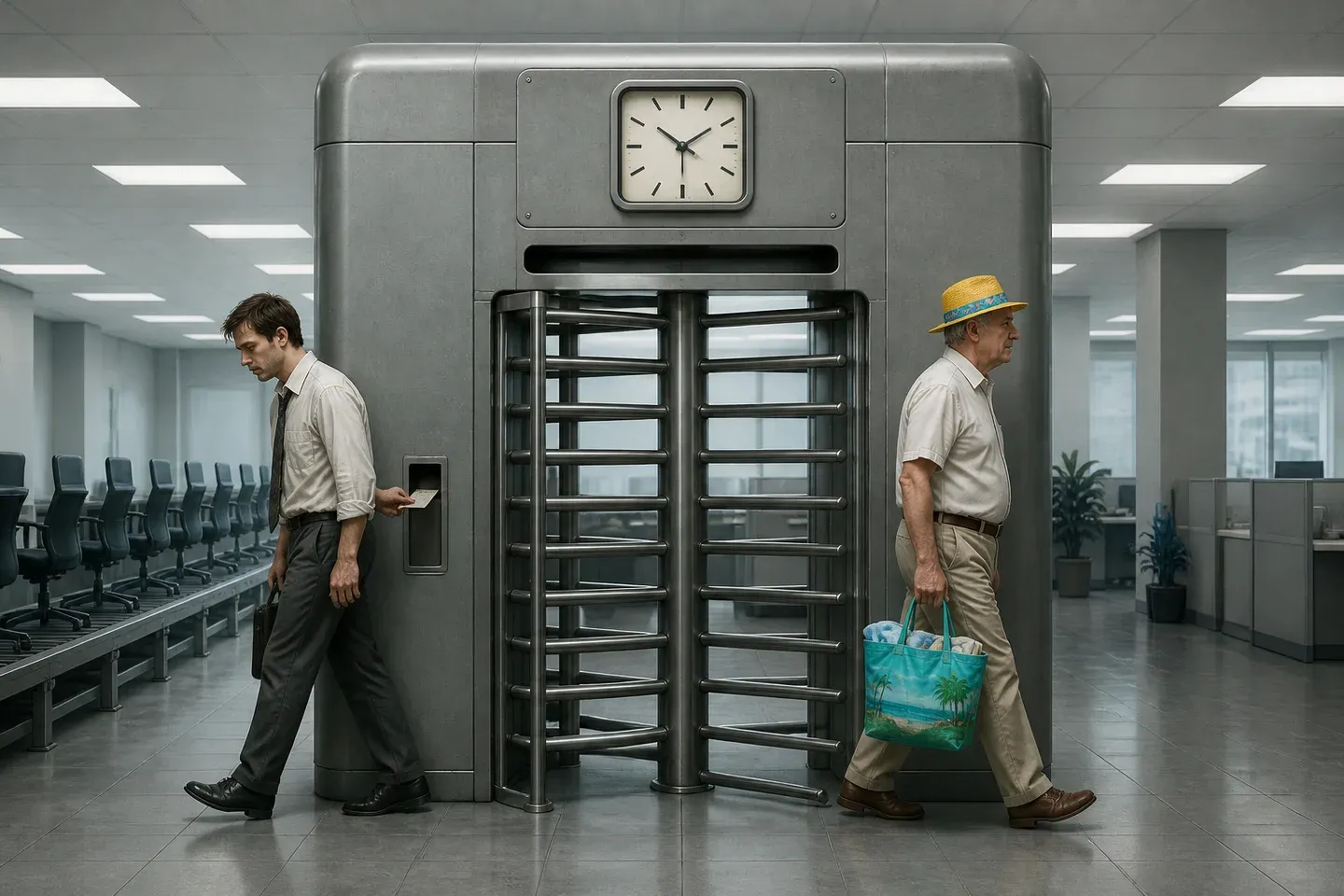
Congratulations: basic humanity, now with an early-bird hip replacement.
The modern retirement age was not delivered on stone tablets next to the commandment about keeping the Sabbath. It was built.
In the 1880s, Otto von Bismarck’s Germany introduced old-age social insurance amid anxiety over worker insecurity and unrest. The United States established old-age benefits through the Social Security Act of 1935, with payments beginning in 1940. After World War II, unions and large companies expanded employer pensions.
This was real progress. It recognized a fact the modern personal-finance industry treats like an embarrassing family secret: one person cannot reliably protect themselves from every market crash, illness, layoff, caregiving crisis, and burst of bad luck over 40 years.
But retirement also suited employers beautifully.
Older, higher-paid workers could leave; succession could be managed; payroll costs could be trimmed. And instead of saying, “Thank you for your service; we are removing you from the budget,” companies created the ceremonial camouflage:
-
The cake
-
The watch
-
The speech about “the next chapter”
-
The group photo in which everyone looks like they have just escaped a hostage situation
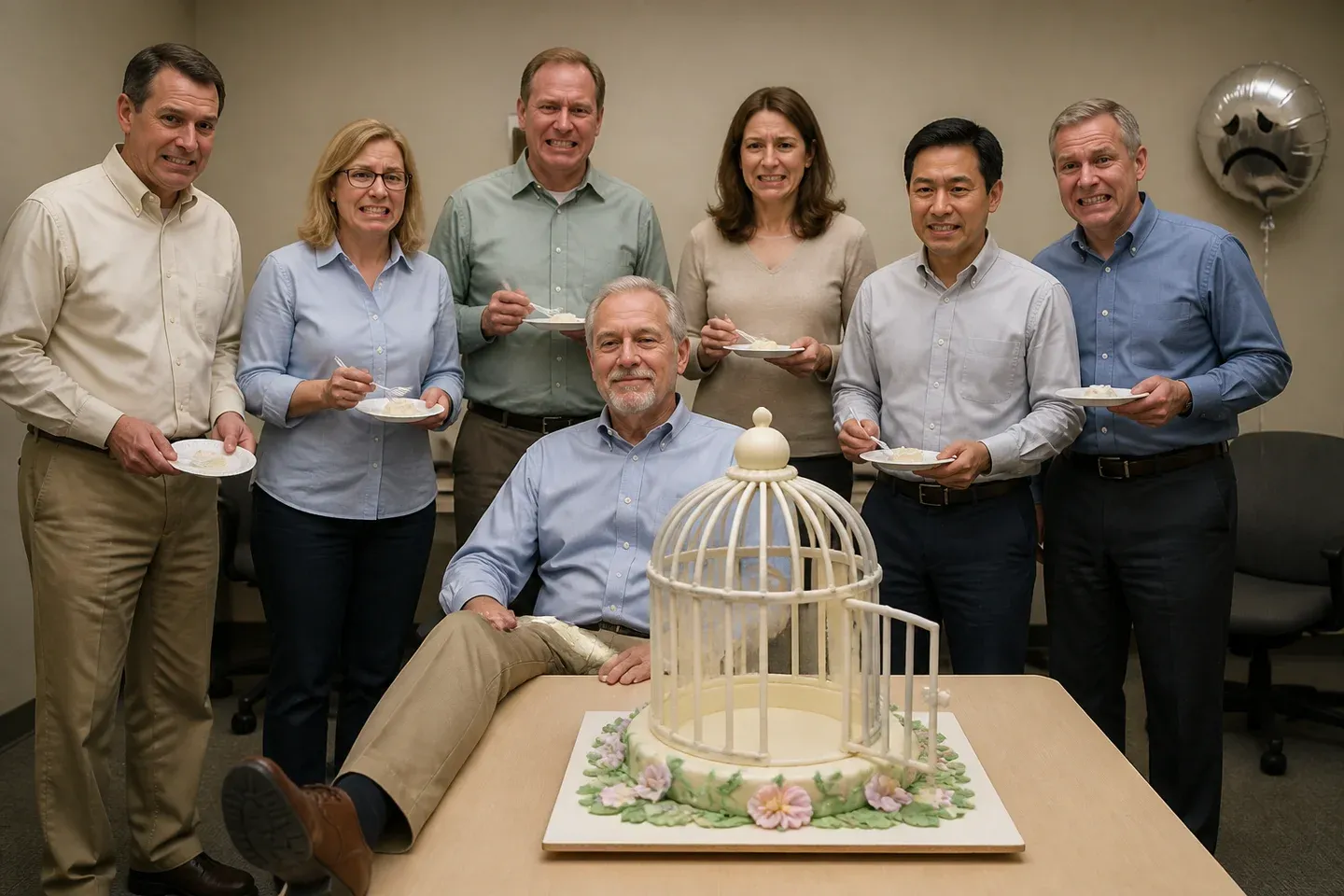
The frosting says goodbye. The budget says finally.
Exclusion, but with frosting.
First, the Pension. Then, the Spreadsheet With a Beach Photo.
Traditional defined-benefit pensions were a serious promise: work here long enough, earn enough, and receive a predictable income in retirement. The employer carried much of the risk that markets would plunge or that you would have the audacity to live a long time.
Then much of the private sector replaced that model with the 401(k): a system in which workers are invited to become unpaid, untrained pension-fund managers while also doing their actual jobs.
| The old bargain | The newer bargain |
|---|---|
| Employer bears much of the investment and longevity risk | Worker bears investment, timing, fee, contribution, and longevity risk |
| Predictable retirement income | A menu of funds and several terrifying calculators |
| Collective protection | Good luck, but start early! |
Employers may offer a match. That matters. Savings matter too. Compound interest is not a conspiracy invented by men named Chad at a seminar.
But the broader arrangement is unmistakable: risk was moved downhill.
The golden watch became a webinar called something like Designing Your Future, where a cheerful financial professional asks you to picture Tuscany at 67 while your employer offers too little paid leave to visit the next county at 37.
The Retirement Calculator Has Never Met Your Actual Life
Financial advice often sounds harmless because, in isolation, it is harmless:
-
Save early.
-
Automate contributions.
-
Diversify.
-
Avoid spending too much.
-
Somehow maintain stable employment, good health, affordable housing, a functional family life, and no inconvenient emergencies for four decades.
That last part is rarely bolded in the brochure.
The standard instruction — save 10 or 15 percent of your income for decades — assumes income remains available after rent, debt, child care, medication, groceries, transportation, and the small expense category known as “everything that happens to a human being.”
A retirement calculator cannot create money from a paycheck that already disappeared on Tuesday.
Nor can a target-date fund repair a shoulder wrecked in a warehouse, restore sleep lost to unstable shifts, or absorb the income hit when a parent needs care, a child needs help, a marriage ends, or a body becomes less employable because of the work that paid the bills.
Yet the financial industry’s preferred moral is wonderfully convenient:
Your future is in your hands — provided your hands correctly navigate tax rules, insurance products, market volatility, employment instability, and the passage of time.
This is empowerment in the same way assembling your own parachute is empowerment.

Your safety net ships flat-packed.
Some People Get an Off-Ramp. Others Get a Cliff.
A well-paid professional with a paid-off home, an employer match, flexible work, and a job that has not physically ground them down may genuinely have choices. They can reduce hours, consult, travel, or retire on their own terms.
A home-health aide, cashier, agricultural worker, construction worker, warehouse worker, or nurse may face a less charming menu:
-
Keep working through pain and exhaustion.
-
Leave work and take the financial hit.
-
Try to stretch a body that has already spent years subsidizing somebody else’s efficiency.
This is why arguments about raising the retirement age often become grotesquely abstract. On a spreadsheet, delaying retirement can mean a larger monthly check. In a real body — especially one worn down by physically or emotionally punishing work — it can mean asking someone to continue paying for the economy with their joints.
Research consistently finds major differences in life expectancy and healthy life expectancy by income, education, and occupation. The question is not merely who lives long enough to collect benefits. It is who arrives at later life with enough mobility, security, and energy to do something besides attend medical appointments and calculate grocery prices.
A later retirement age may look actuarially tidy while functioning as a regressive tax on worn-out bodies.
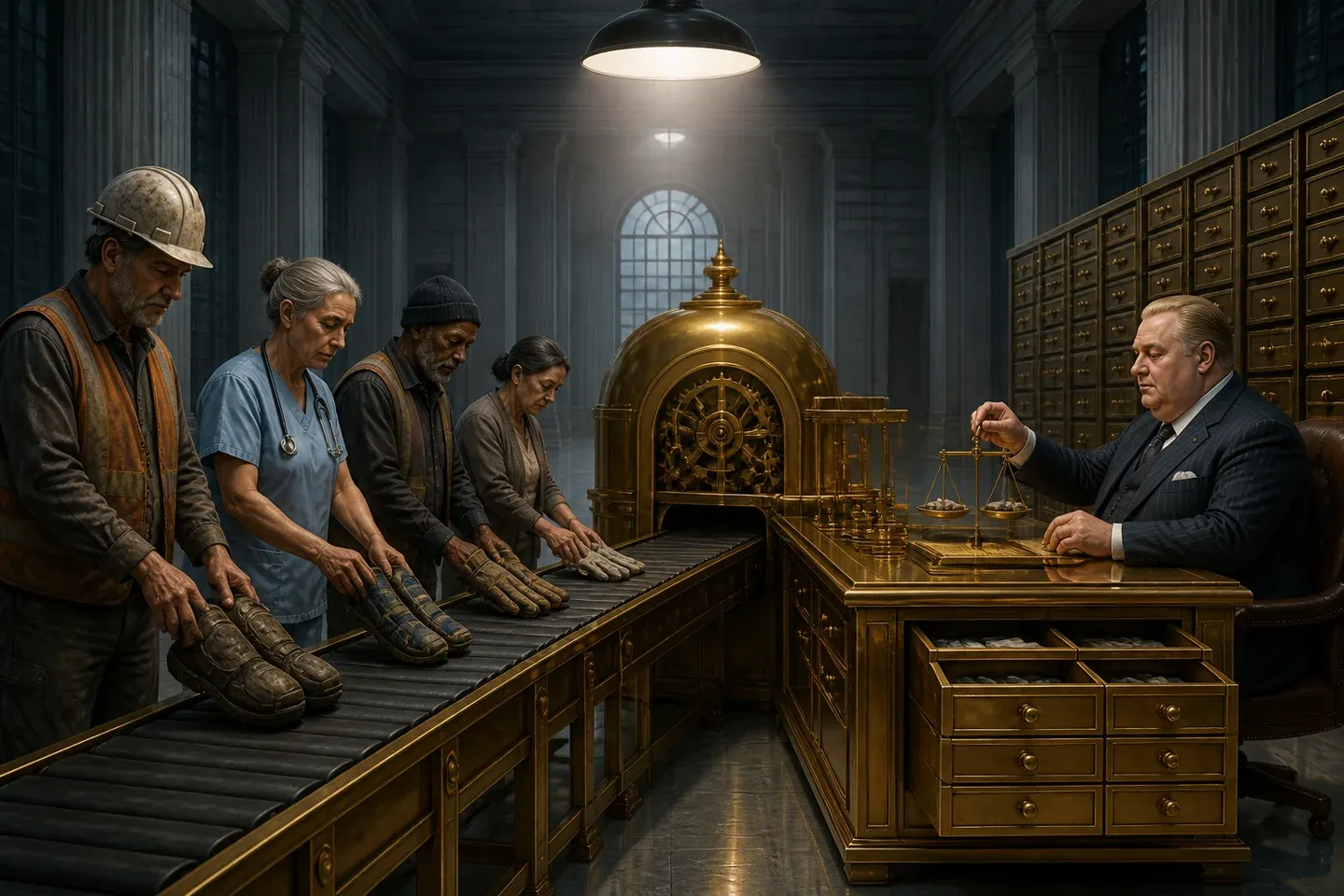
The math balances once you remove the cartilage.
The Happy Retirees Are Visible Because They’re at the Airport
The cultural image of retirement is suspiciously curated: healthy couples in RVs, people on pickleball courts, vacation photos, a mortgage-free home glowing in late-afternoon light.
Meanwhile, less camera-friendly retirement exists right beside it:
-
People who leave work because of disability, not desire.
-
People who keep working because stopping is unaffordable.
-
People caring for spouses, grandchildren, or aging parents.
-
People who die before drawing much benefit from the security they spent decades chasing.
-
Women with interrupted careers and lower lifetime earnings from unpaid caregiving — who also tend to live longer, so their savings must stretch further.
Race, gender, family structure, access to homeownership, inherited wealth, pension coverage, discrimination, gig work, immigration status: all of it shapes who gets to treat retirement as freedom and who gets to treat it as a financial weather emergency.
The smiling couple in the advertisement is not a universal life stage. It is a class-specific outcome dressed up as normal.
And longevity, normally celebrated as a blessing, gets repackaged as a personal financial threat: the danger that you will have the nerve to outlive your money.
Stop Hoarding All the Freedom Until the End
The answer is not to romanticize endless work. Work can offer income, purpose, friendships, skill, routine, and a reason to wear pants before noon. Some people want to keep doing it long after any official retirement age.
The answer is to reject the ludicrous arrangement in which adulthood means near-total availability to the labor market, followed by a single delayed permission slip for autonomy.
A humane society would spread more freedom across a life, rather than storing it all in the final chapter like emergency rations.
That means building conditions in which “balance” is not corporate wallpaper:
-
Shorter standard workweeks where productivity permits
-
Paid vacation and family and medical leave
-
Safer workplaces and predictable schedules
-
Health care not tied to a job
-
Portable benefits for people whose work does not fit the old stable-employer model
-
Stronger public pensions and caregiving credits
-
Phased retirement that does not turn reduced hours into poverty
-
Affordable housing and long-term care
None of this is exotic. The workweek was made by organizing, legislation, and productivity gains. It can be remade. Society already accepts that a particular birthday can mark the border between work and freedom. It could build smaller borders throughout adulthood: time to recover, learn, care for family, travel, participate in civic life, or simply be idle without treating it as a suspicious accounting error.
Save for old age. Protect retirement. Fight for the right to leave work with dignity.
But stop pretending present life is merely a leak in the long-term plan.
No account balance can refund years that were systematically withheld from living.
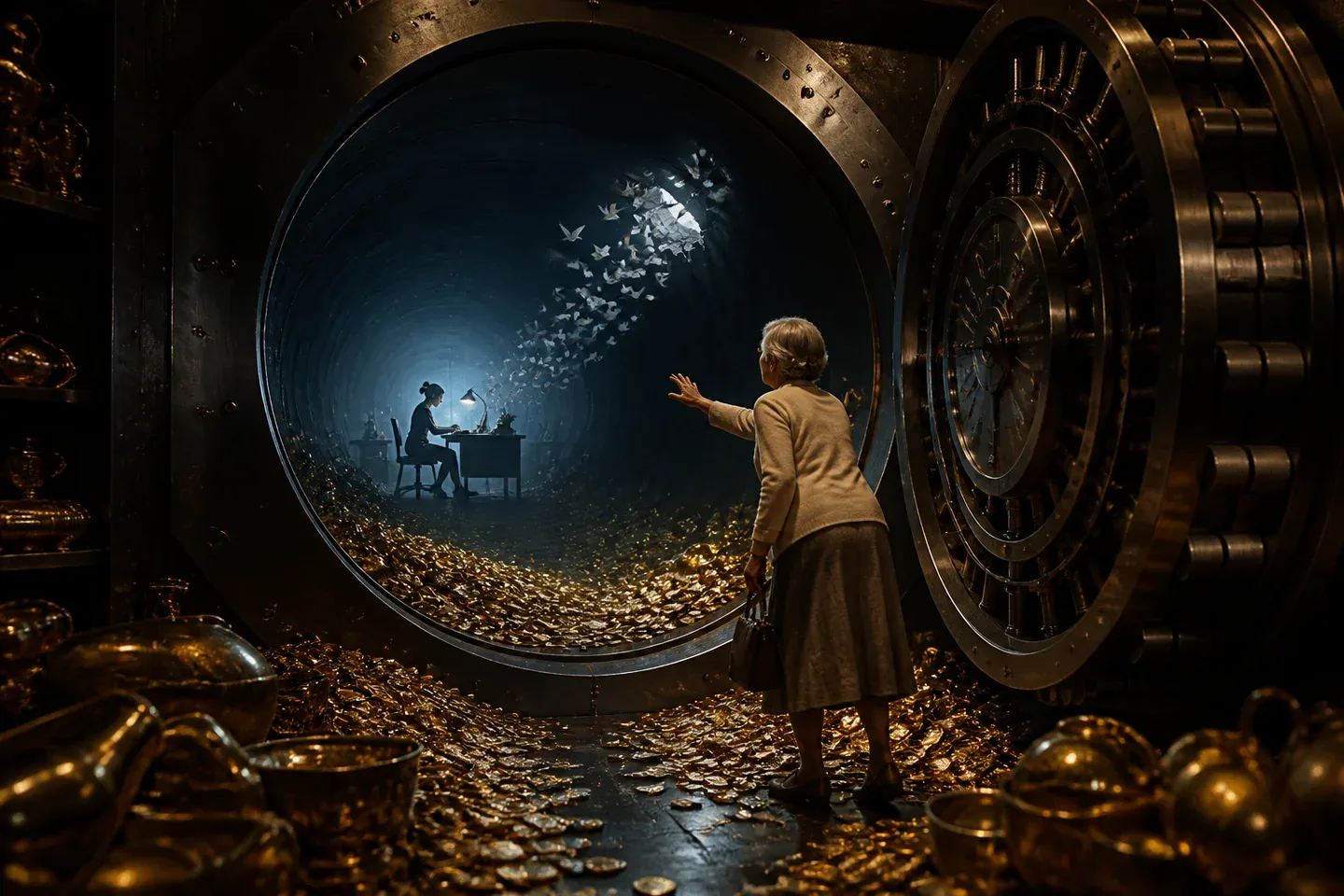
The vault opened. The years had already left.