The K-Shaped Economy Is a Staircase Where One Side Has a Jetpack
The Letter K Is Doing a Lot of Emotional Heavy Lifting

The “K-shaped economy” sounds like a graph. It is actually what happens when the economy looks at two people and says, “You get a house. You get a second job.”
One line rises toward people who own stocks, real estate, companies, and the machines doing the work. The other drops toward people whose main asset is the next hour of their life, which they must sell before rent notices them.
Federal Reserve data around 2022 put the contrast in cartoonishly large numbers: the richest 10 percent of Americans owned roughly 67 percent of the country’s wealth, while the bottom half owned about 2.5 percent.
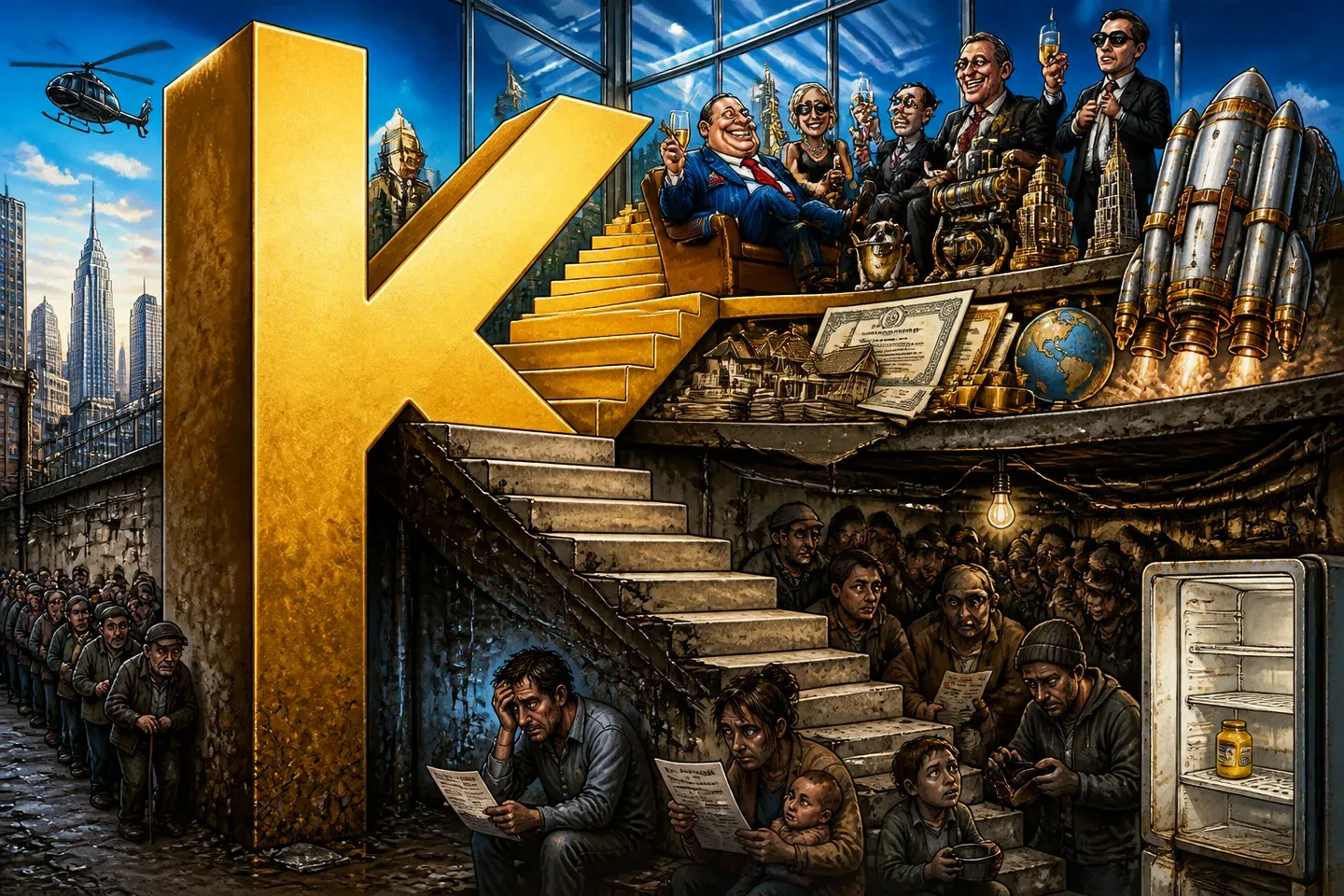
The economy’s official wealth-distribution policy: one person gets the jetpack, everyone else gets a receipt.
That is less a distribution than a magician making the money disappear and then asking the audience to clap.
Wealth compounds. So does access. If you can afford to fail, you can experiment. If you can experiment, you can find something valuable. If you find something valuable, you buy more assets. Meanwhile, the person living paycheck to paycheck is told to “take a risk,” which is adorable advice from anyone whose refrigerator contains food and not just a jar of mustard named Kevin.
Artificial intelligence is entering this mess like a forklift in a pottery store. It can lift enormous amounts of work—but whoever owns the forklift gets to decide where the pottery goes.
AI Is a Power Tool, Not a Deed to the House
The technology can already draft, summarize, research, translate, sort data, scaffold code, answer customer questions, and turn a recurring office chore into a button. That matters because a small team can now attempt work that once required a department, an agency, or six months of savings and a man named Brad who owned three monitors.
A 2023 study of 5,179 customer-support agents by researchers from MIT, Stanford, and the National Bureau of Economic Research found that generative AI increased productivity by about 14 percent overall, with a 34 percent boost for novice and lower-skilled workers. The least experienced workers benefited most because the system effectively handed them the advice of the better agents.
That is the hopeful part. The terrifying part is that “productivity increased” does not automatically mean “worker gets more money.” It can also mean the company discovers that the same number of people can now handle twice as many angry emails before lunch.
Two people can use the same AI and end up in completely different economic universes:
| Person | Uses AI to… | Result |
|---|---|---|
| A | Finish assigned reports faster | Be rewarded with more reports |
| B | Find a repeated business problem and build a system around it | Own a service people keep paying for |
Person A has become a faster employee. Person B has created leverage.
That distinction is the whole game. If AI helps you complete one task more quickly, you have improved your labor. If it helps you turn a repeated task into a product, process, subscription, customer relationship, or piece of intellectual property, you may have created an asset.
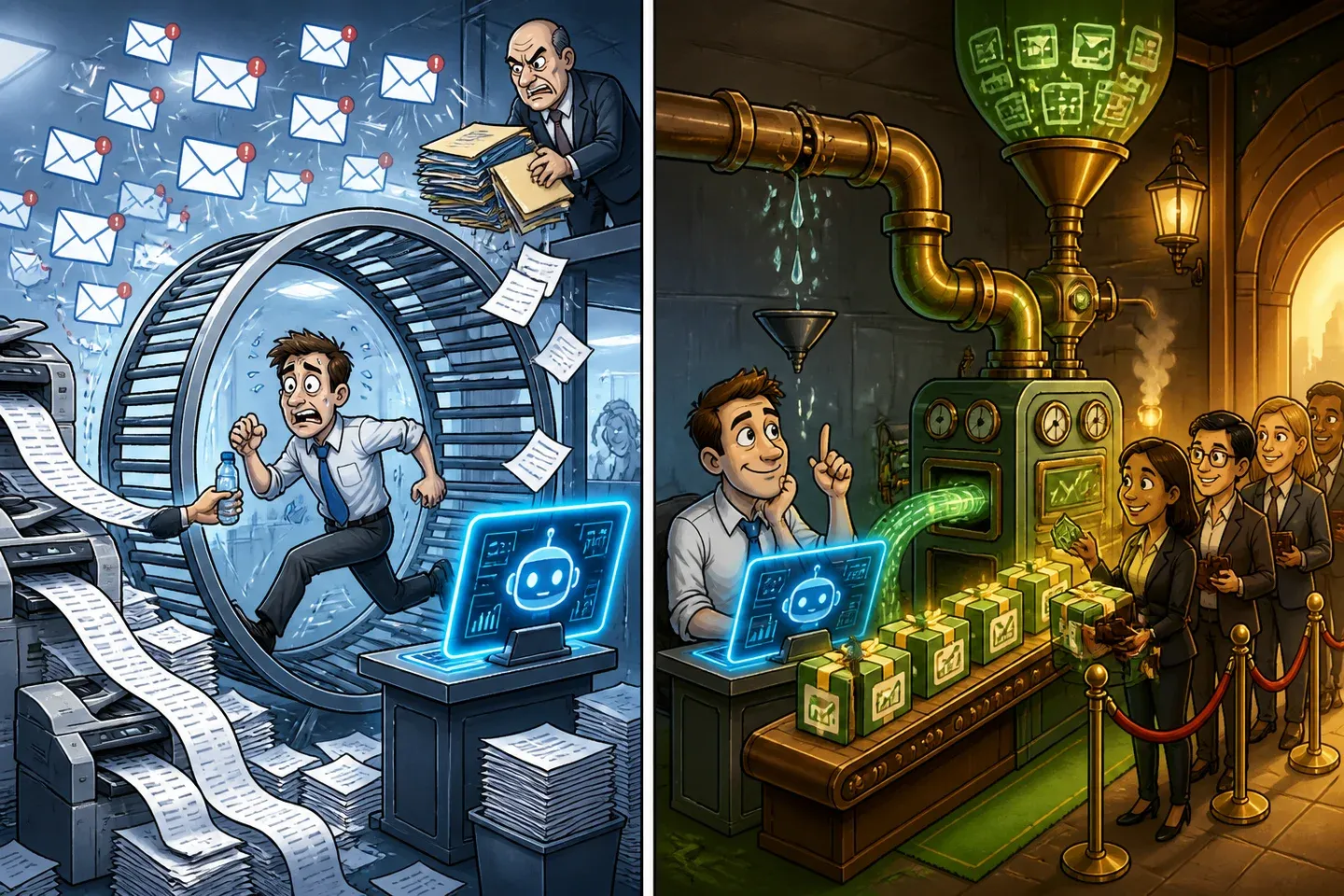
One hamster got better analytics. The other quietly became the landlord.
A faster hamster wheel is still a hamster wheel. It just has better analytics.
The valuable skill is not making a chatbot write a passable paragraph. Your uncle can do that now, and he still believes every Facebook post about putting onions in your socks. The valuable skill is knowing:
-
What problem is worth solving
-
Which parts can be automated
-
Where the machine will confidently make things up
-
What requires human judgment
-
Who will pay for the result
-
Who is responsible when it catches fire
That last one is important. AI can generate an answer. It cannot attend the meeting where the answer ruins everyone’s quarter.
The Person Who Knows Where the Pipe Bursts Wins
You do not need to be a programmer. You need to understand a real bottleneck.
A nurse knows where a hospital workflow turns into a bureaucratic hostage situation. A mechanic knows which maintenance process eats three hours for no reason. A teacher knows the difference between “this student needs more practice” and “this student is terrified of looking stupid.” A lawyer knows the narrow, expensive problem clients keep bringing back like a cursed heirloom.
Generic tool knowledge is useful. Domain knowledge tells you where to point the cannon.
Imagine a tradesperson using AI to produce estimates, schedule jobs, track inventory, and follow up with customers. The machine handles the paperwork; the human still does the work that requires judgment, physical presence, and trust. Or imagine a small agency automating first-pass research so its staff can spend more time on strategy instead of copying information between spreadsheets like monks preserving a sacred prophecy about quarterly leads.
The point is not to automate every human action. That would leave us with a society of unemployed people supervising machines that send each other calendar invitations.
The point is to move your effort toward the parts that remain scarce:
-
Deciding what matters
-
Understanding context
-
Catching errors
-
Earning trust
-
Handling consequences
-
Communicating a clear point of view
-
Making choices when the information is incomplete
The machines may eventually imitate conversation, diagnosis, creativity, negotiation, and emotional warmth. Fine. Let them. The question is not whether a machine can perform a task in a laboratory. It is whether somebody will trust it with a frightened patient, an angry customer, a child, a lawsuit, or the company’s money.
And even if they do, someone still has to decide what the machine should do. Every revolution eventually needs a person who says, “No, the robot should not email that to the entire hospital.”
Productivity Without Ownership Is Just a More Efficient Way to Lose
Here is where the K gets uglier.
A company can give workers AI tools and capture nearly all the benefit through layoffs, heavier workloads, surveillance, or frozen wages. The employee becomes more productive. The company becomes more valuable. The employee receives a motivational water bottle.
That is why “learn AI” is incomplete advice. Learn it for what? To make yourself easier to monitor? To perform the work of three people for the salary of one? To create a system your employer owns while you remain one reorganization away from updating your résumé in a panic?
If the value you create disappears into someone else’s platform, your position may not improve. A social-media audience can vanish when an algorithm changes. A company can claim ownership of everything produced on company time. A platform can raise its fees, bury your work, or decide your perfectly legitimate business now violates community standards.
A personal brand is often just a rented storefront with a landlord who can change the locks overnight.
The goal is not for every person to become a founder, freelancer, or exhausted LinkedIn prophet. It is to make some part of your new productivity portable and visible:
-
A specialized service
-
A reusable workflow
-
A direct customer relationship
-
A proprietary database
-
A reputation for solving one painful problem
-
A stake in the company benefiting from your work
-
Enough expertise to negotiate better terms—or leave
If an AI system saves your employer ten hours a week, that should not automatically become ten additional hours of labor. It could become more pay, more time, more authority, training, or ownership. Otherwise, “AI-enabled” is just corporate for “we found a way to remove your lunch break mathematically.”
The Ladder Could Vanish While Everyone Is Told to Climb Faster
There is a genuine danger beyond layoffs: entry-level work has traditionally been how people become experienced. Beginners do routine tasks, observe experts, make small mistakes, and gradually learn where the complicated mistakes are hiding.
If AI takes all the beginner work, the economy may produce a strange new species: senior employees with no juniors, because the juniors were deleted before they learned anything.
The technology also creates obvious problems involving privacy, copyright, cybersecurity, bias, and reliability. A system that saves time while turning every worker’s keystroke into surveillance is not liberation. It is a productivity prison with excellent autocomplete.
And the costs cannot be dumped onto individuals. Telling a cashier working two jobs to “become an AI entrepreneur” is like telling someone drowning to monetize their swimming technique.
Schools, libraries, employers, and governments have to provide access, training, verification skills, privacy protections, and real pathways into new work. Workers should have a say in how automation changes their jobs and how the gains are distributed. Nobody should need a venture-capital pitch deck to survive a software update.
For individuals, the practical move is smaller and less glamorous:
-
Find one recurring process that wastes time or creates measurable value.
-
Use AI to improve it.
-
Keep human review where mistakes cost money, safety, or trust.
-
Measure what actually improved.
-
Turn the result into bargaining power, a portable skill, or something you own.
One workflow will not make you rich. It may teach you how value is created before the companies with private data centers and legal departments finish building the tollbooth.
The K-shaped economy is real. So is the advantage of already having money. AI will not magically rescue people from inequality; it can just as easily make the rich richer and the exhausted more efficiently exhausted.
But the central question has changed. It is no longer merely whether a machine can do your task.
It is who directs the machine, who gets paid for what it produces, and whether your contribution ends when the hour is over—or keeps working after you leave the room.

The worker clocked out. The machine kept earning. Somehow, the machine still got a better performance review.