The Internet Hired a Robot Bouncer, and Now Your Rent Depends on Impressing Him
Please Perform the Sacred Keyword Dance


Somewhere right now, a bakery owner is changing “birthday cakes” to “custom birthday cakes near me” because a dashboard suggested customers have lost the ability to recognize flour unless it contains metadata.
A journalist is refreshing Google Search Console like it’s a hospital monitor. A musician is begging fans to “save, share, comment, and sacrifice a goat during the first 30 seconds.” A restaurant is one ranking update away from becoming an extremely expensive private kitchen.
Making good work is no longer enough. Your work must impress an invisible machine that communicates exclusively through traffic collapses and emails titled Exciting Changes to Discovery.
“The algorithm” isn’t one evil computer stroking a hairless cat. It’s Google ordering search results, TikTok choosing videos, Amazon arranging products, Spotify steering music, hiring software binning résumés, and delivery apps deciding whether your noodle shop exists.
The bargain sounds lovely:
“Give us your location, contacts, purchases, searches, pauses, late-night medical panics, and the exact millisecond you stopped watching a video. In return, here is a funny dog.”
Then visibility becomes survival, and suddenly the funny-dog company controls whether you can make payroll.
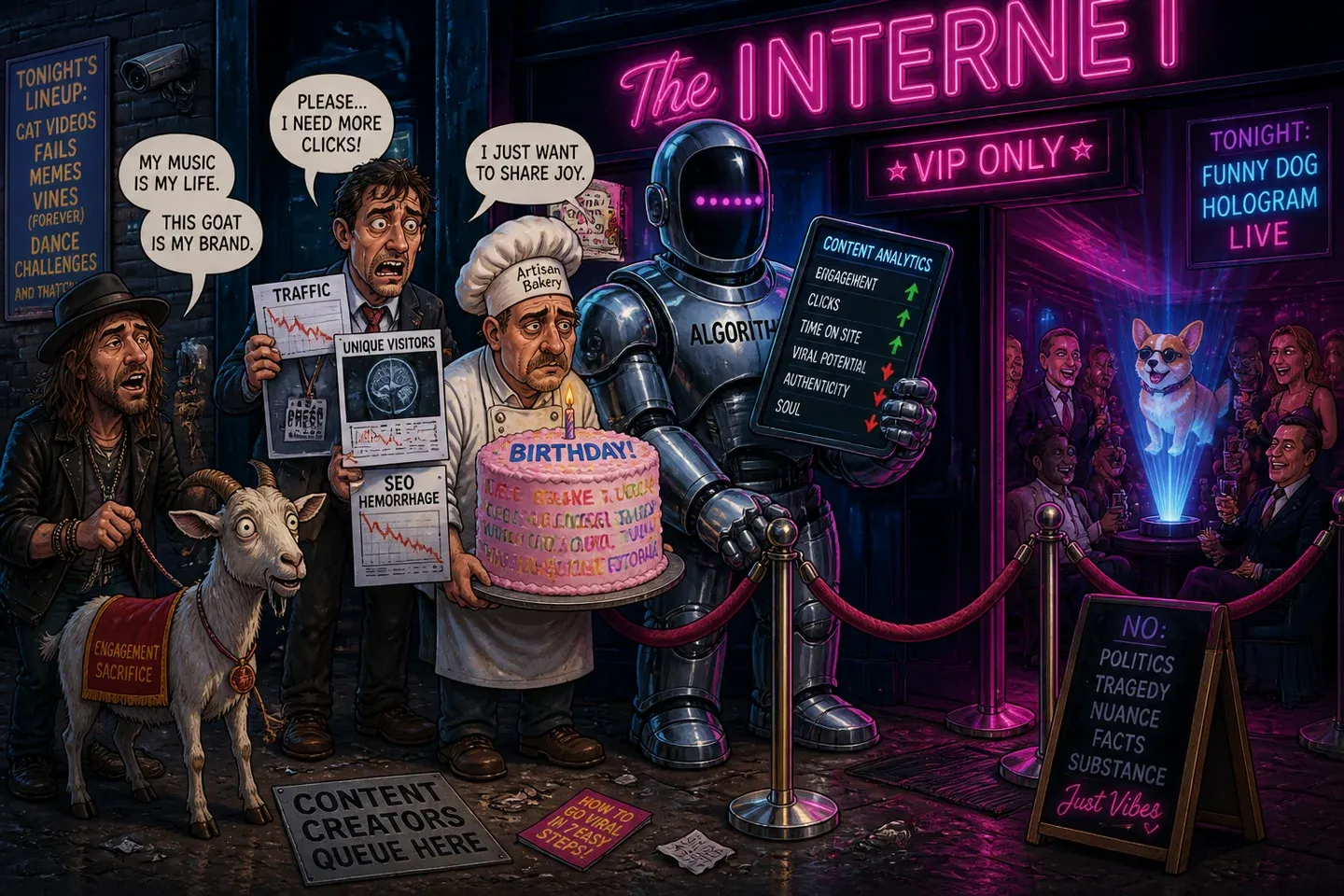
Tonight’s dress code is “organically viral,” and the goat is somehow underperforming.
Independent air-purifier review site HouseFresh said Google traffic fell from roughly 4,000 daily visitors to about 200 after a series of updates. That’s not “engagement fluctuated.” That’s Google quietly moving your store into a ravine.
We Optimized the Internet Until It Became Soup
SEO trained everyone to write for machines while maintaining eye contact with humans.
That’s why recipes begin with 1,700 words about Grandma’s emotional relationship with paprika. It’s why every product review is titled “Best Toaster 2024: We Tested 73 Toasters, Somehow Without Alerting the Fire Department.” It’s why six websites answer “What time does Aldi close?” with biographies of the Aldi brothers.
The internet started producing what search engines rewarded:
| Humans wanted | The machine received |
|---|---|
| A pancake recipe | My Journey Through Batter: Chapter One |
| A decent laptop | 38 affiliate links wearing a trench coat |
| Store hours | A 900-word “comprehensive guide” to clocks |
| Medical information | “You may have gas, cancer, or gas cancer” |
At least old Google usually showed links. You could compare sources, ignore the haunted coupon website, and eventually find a person who knew something.
Then the chatbot arrived and ate the menu.
The Concierge Has Swallowed the Library
Google rolled out AI Overviews broadly in the United States in 2024. Instead of sending you toward sources, search could now assemble an answer before you clicked anything.
A 2024 analysis by SparkToro and Datos estimated that for every 1,000 Google searches in the U.S., only 360 produced a click to the open web. Nearly 60 percent ended without any click at all.
The remaining clicks presumably escaped through a ventilation shaft.
This is wonderful when you need to know how many tablespoons are in a cup. It is less wonderful when your reporting, review, photograph, or tutorial supplied the answer and the machine responds:
“I have absorbed Brenda’s seven years of expertise. Brenda will receive twelve cents and a visit from our crawler at 3:14 a.m.”

Brenda’s complete works are now available in convenient don’t-visit-Brenda format.
Here is the new information economy:
-
A human spends months discovering something.
-
A platform ingests it.
-
An AI summarizes it.
-
The user never visits the human.
-
The human loses revenue.
-
The platform wonders why nobody is producing trustworthy information anymore.
-
The AI generates some.
And fluency is not accuracy. In 2023, Futurism reviewed 77 AI-written finance articles published by CNET and found errors in 41 of them. CNET issued corrections, proving the future had arrived: a machine confidently explains compound interest, and a human follows behind with a mop.
“Neutral” Is What Computers Call Themselves Before the Lawsuit
A chatbot still ranks sources. It chooses what to retrieve, whom to quote, what to omit, and which answer gets served with the verbal confidence of a submarine captain who has never seen water.
That matters when it recommends socks. It matters more when software touches employment or health.
In a 2019 Science study, researchers found that a widely used health-care algorithm underestimated the needs of Black patients because it used past health spending as a proxy for illness. Since unequal access meant less money had historically been spent on Black patients, the machine concluded they were healthier. Correcting the bias would have increased the share of Black patients selected for extra care from 17.7 percent to 46.5 percent.
The computer wasn’t racist in the human sense. It merely converted decades of inequality into a spreadsheet and called the output objective.
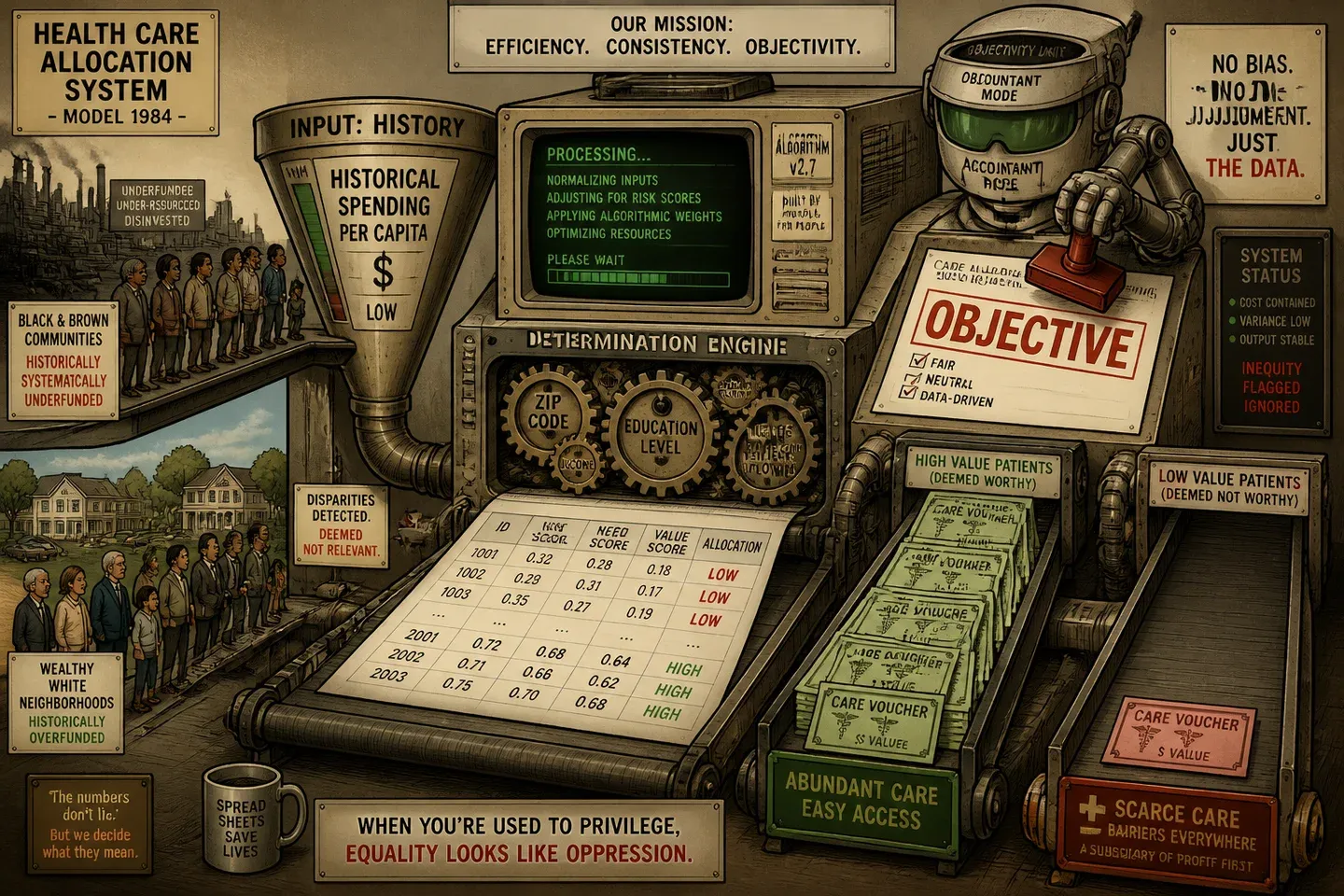
Good news: centuries of inequality passed the vibe check and are now a dropdown menu.
Now imagine that same opacity choosing your contractor, insurance plan, hotel, doctor, news, and next job—then completing the purchase before you’ve finished asking the question.
Search was a bouncer. AI wants to be the bouncer, concierge, personal shopper, travel agent, and friend who says, “Trust me, this one’s perfect,” while quietly receiving money from the hotel.
And the biggest companies are already buying better seats at the robot’s dinner table:
-
Reuters reported Google agreed to pay Reddit about $60 million a year for access to its content.
-
The Wall Street Journal reported OpenAI’s deal with News Corp could be worth more than $250 million over five years.
-
Smaller publishers receive the traditional compensation package: exposure, scraping, and a PDF explaining innovation.
Fine, What Do We Do—Mail Each Other Websites?
Creators and small businesses should treat platform traffic like a rented apartment whose landlord keeps measuring the windows.
Build things the gatekeeper cannot casually confiscate:
-
Email lists you have permission to use
-
Direct subscriptions and customer relationships
-
Multiple sources of revenue and referrals
-
Firsthand reporting, original data, real expertise, and a voice harder to puree into chatbot oatmeal
-
Communities that know your name instead of merely recognizing your thumbnail
Users can help by clicking through, subscribing, bookmarking, supporting local journalism, and checking primary sources whenever the stakes exceed “Which blender can liquefy a Lego?”
But personal virtue cannot fix infrastructure. We need privacy rules, data portability, independent audits, meaningful appeals, clear citation standards, and consequences when automated systems destroy livelihoods or deny people opportunities. “The model did it” should carry roughly the same legal weight as “a raccoon approved the mortgage.”
Algorithms are not weather. Executives choose what they optimize: watch time, purchases, retention, legal safety, profit. Those choices decide who gets seen, paid, hired, treated, or quietly erased.
The old web offered a million doors. Platforms narrowed them to a few guarded gates. AI now proposes one smiling concierge who knows your budget, medication, calendar, politics, and favorite sandwich.
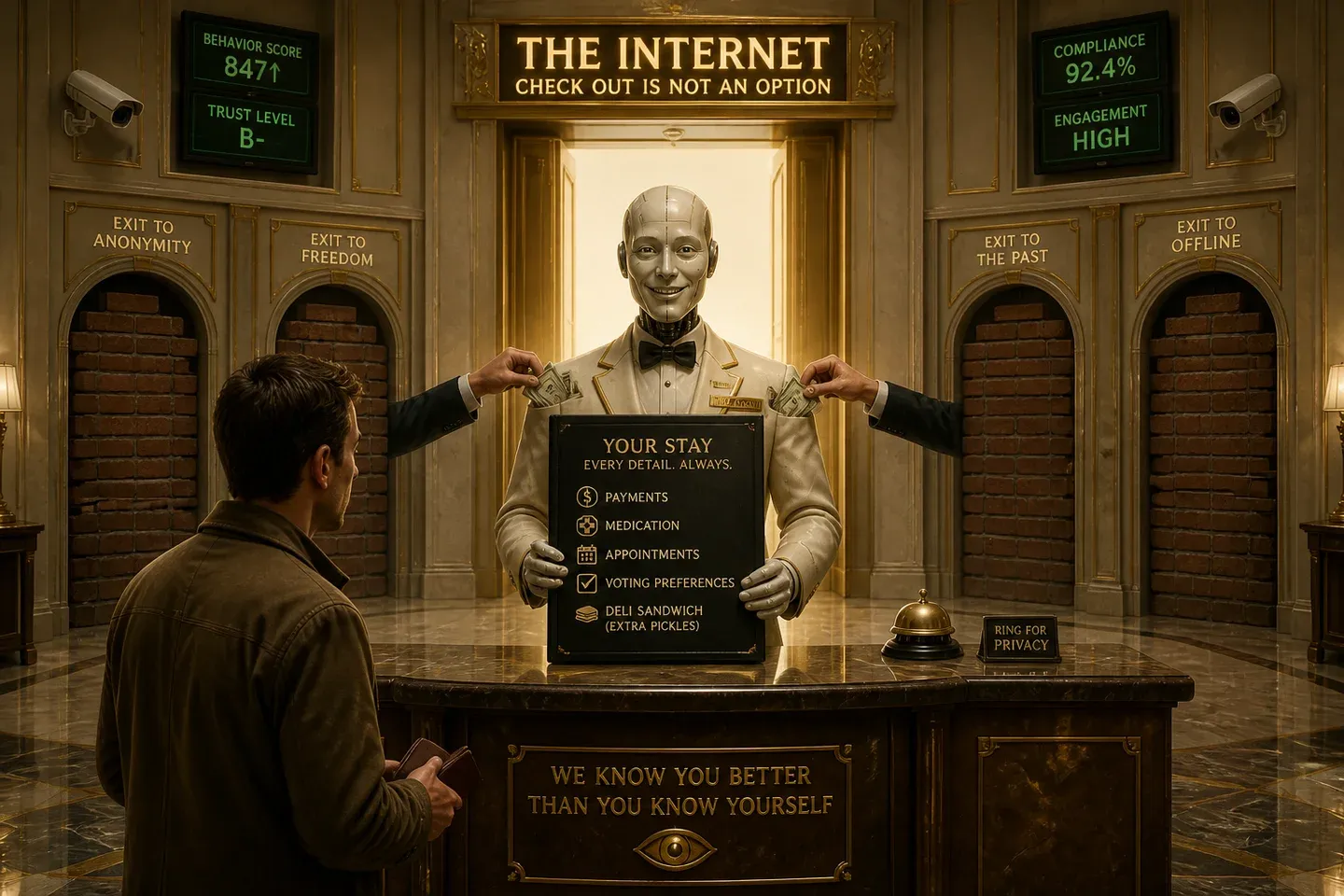
He remembers your sandwich order because the sandwich has a higher marketing budget than you.
He insists the service is free.
He will not say who tipped him.