The Internet Isn't Dead. It's Just Wearing a Fake Mustache and Asking You to Buy Supplements.
Your Brain Was Built for a Village, Not 80,000 Fake Neighbors


You know that weird feeling when a post has been up for eleven minutes and already has 4,000 comments?
Half of them are furious. Half are delighted. One guy named PatriotDad1976 has somehow written a 900-word eyewitness account of the thing that happened six minutes ago. Three accounts with profile pictures generated by a haunted Sears portrait studio are saying, “Wow, nobody is talking about this.”
Everybody is talking about it.
Which is exactly the problem.
The “dead internet” isn’t the theory that every person online is a bot, every bird photo is CGI, and your grandmother’s Facebook prayer chain is being run by a server rack in Nevada. Real people are still here. We’re still posting bad takes, photos of sandwiches, and medical emergencies under YouTube videos.
The problem is that the internet’s old shortcut for trust — “Well, a bunch of people seem to agree” — has been replaced by a fog machine with Wi-Fi.
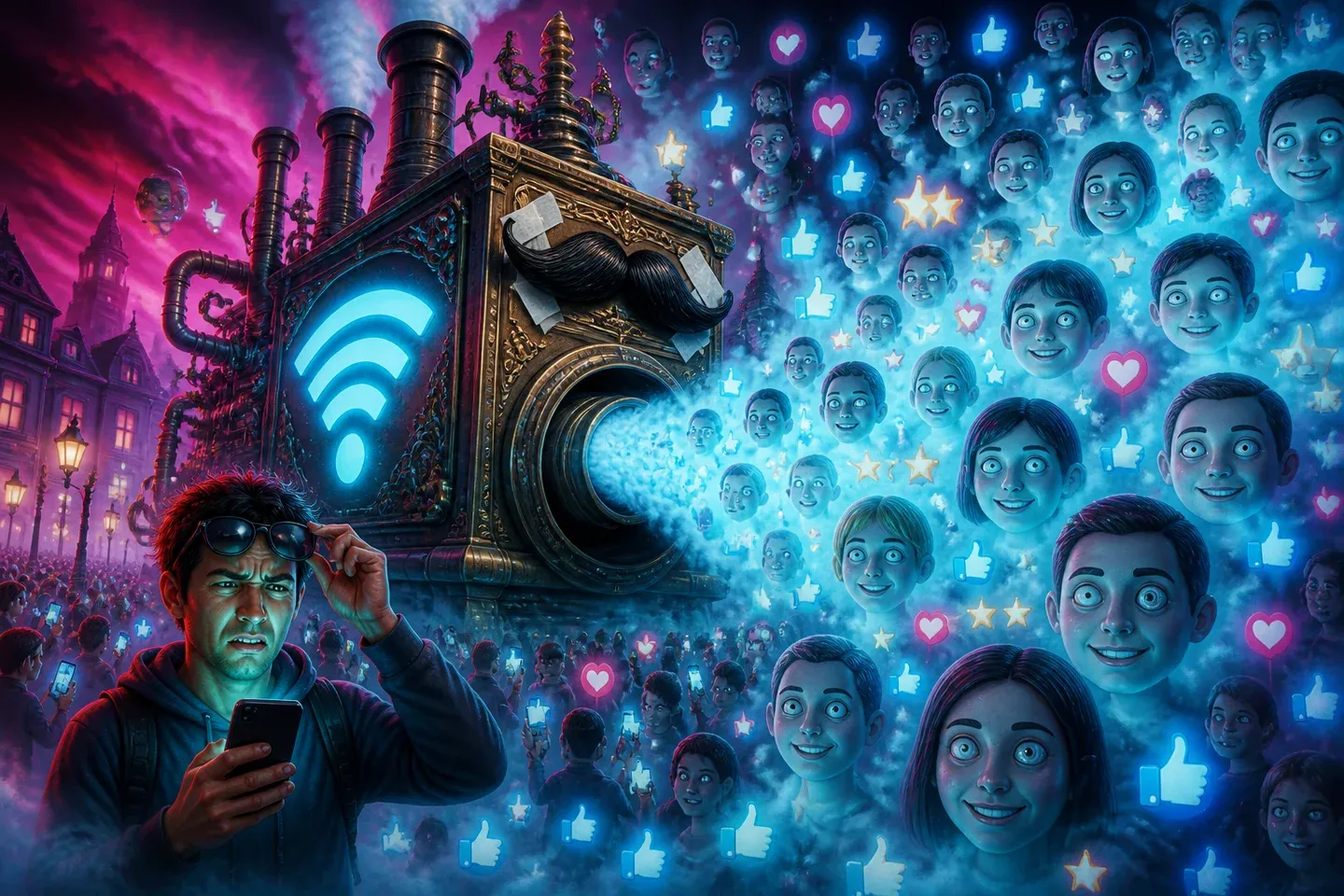
Nothing says “public consensus” like 8,000 identical strangers emerging from a vape cloud to recommend iodine gummies.
Human beings use crowds as evidence because we cannot personally investigate every restaurant, candidate, skin cream, miracle investment, cancer treatment, or video claiming that a school bus contains “the truth the media won’t show you.”
So we look sideways.
“This product has 5,000 reviews.”
“This post has 40,000 shares.”
“Everybody in the comments says this doctor is lying.”
“Surely the comments section would not deceive me. It has little heart icons.”
Unfortunately, the comments section is now the digital equivalent of asking a mall food-court crowd whether you should refinance your house.
A fake review can make you buy a terrible blender. A fake consensus can make you think your neighbors want a book banned, a vaccine feared, a politician worshipped, or a stranger harassed into hiding.
Facebook told Congress that content from Russia’s Internet Research Agency may have reached 126 million Americans from 2015 to 2017. Not because 126 million Americans woke up craving foreign influence with their Pop-Tarts. Because fake accounts can look like anybody: local activists, veterans, parents, dog enthusiasts, people who are somehow very concerned about zoning laws despite having no detectable pulse.
Generative AI has made this cheaper. Before, convincing strangers required humans — expensive, inconvenient creatures who need sleep, wages, and occasional breaks from pretending to be an Ohio grandmother. Now one system can crank out:
-
A scary post about a local issue.
-
Fifty supportive comments in different “voices.”
-
A listicle explaining why the scary post is “what they don’t want you to know.”
-
A heartfelt direct message from a concerned “friend.”
-
A product ad selling vitamins to solve the panic it just created.
Congratulations: you have been mugged by a content assembly line.

The deluxe panic package: fear, comments, vitamins, and a free kick in the attention span.
The Robot Doesn’t Need to Hate You. It Just Needs a Bonus Structure.
Nobody has to program an AI to become a movie villain. It doesn’t need glowing red eyes, a metal skull, or a monologue about the inferiority of flesh.
Just tell a system to maximize engagement.
That’s it. That’s the cursed spell.
A machine optimizing for clicks learns that calm facts are decorative parsley. Fear works. Outrage works. Sex works. A headline that makes you yell “WHAT?!” works even better if it turns out to be about a celebrity putting mayonnaise in coffee.
The algorithm does not need beliefs. It has the moral framework of a casino carpet: keep the human confused, stimulated, and unable to locate an exit.
| What the platform calls it | What it often means |
|---|---|
Engagement | You fought with a stranger until 2:14 a.m. |
Community | 900 accounts yelling “SOURCE?” under a funeral announcement |
Personalization | A machine has noticed you are vulnerable to lizard-related misinformation |
Authenticity | A brand hired someone to pretend they discovered the brand |
Trending | The machine decided this needs more gasoline |
The Federal Trade Commission finalized a rule in 2024 banning practices including fake reviews and fake social-media indicators — because apparently we reached the point where the government had to formally announce that businesses may not hire an army of fake people to clap at themselves.
That is not a future dystopia. That is a federal regulation with paperwork.
“Was This Written by AI?” Is the Wrong Question, You Beautiful Paranoid Raccoon
AI can do useful things. It can translate a government form, summarize a dense report, add captions, explain a confusing medical term in plain English, or help somebody navigate bureaucracy without needing a law degree and a machete.
That’s good. A machine helping you find a library is good.
A machine pretending to be your friend, your doctor, your neighbor, a cancer survivor, or the 8,000 totally real customers who loved this collagen powder is social counterfeiting.
So don’t ask whether text has a soul. Your printer doesn’t have a soul either, and it has never once tried to sell you crypto after claiming its aunt died from “mainstream medicine.”
Ask the questions that matter:
-
Who is behind this?
-
What is it trying to make me do?
-
Can I inspect the source?
-
What happens if it’s wrong?
-
Is it honestly labeled, or is it wearing a fake human face because the lie is the product?
Fluent language is not evidence. A chatbot can write “according to a 2019 study” with the serene confidence of a Victorian butler announcing dinner — even if the study does not exist, the journal does not exist, and “Dr. Linda Hamburg of the University of North Florida State” was assembled from spare syllables behind a dumpster.

Dr. Linda Hamburg, MD: three trench coats, a thesaurus, and one aggressively confident comma.
We Don’t Need Less Technology. We Need Less Digital Ventriloquism.
Nobody should need to become a full-time internet detective just to buy headphones or learn whether there’s a flood warning. “Media literacy” is great; telling exhausted people to forensically inspect every review, photo, voice note, comment, and smiling stranger online is not literacy.
It is outsourcing platform failure to whoever has the least free time.
The fixes are not mystical:
-
Label automated accounts clearly.
-
Punish impersonation and coordinated fake engagement like the fraud it is.
-
Make high-stakes AI systems show their sources and uncertainty.
-
Let independent researchers inspect what giant platforms are amplifying.
-
Add friction to mass forwarding, because forwarding “URGENT!!!” to 400 people should require at least one additional thought.
-
Pay and ask permission when companies train systems on creators’ work.
And maybe — call me a wild-eyed radical — stop measuring a platform’s success by whether it can keep a person staring at it until their phone dies in their hand like a tiny glowing tombstone.
The best AI will not be the one that tricks you into treating it like a person. It will be the one that helps you understand something, points you to the original source, and then gets out of your life.
No fake intimacy. No synthetic crowd. No endless applause track.
The internet is still a library. It’s also a library where somebody replaced the intercom system with 10,000 drunk parrots reading sponsored content.
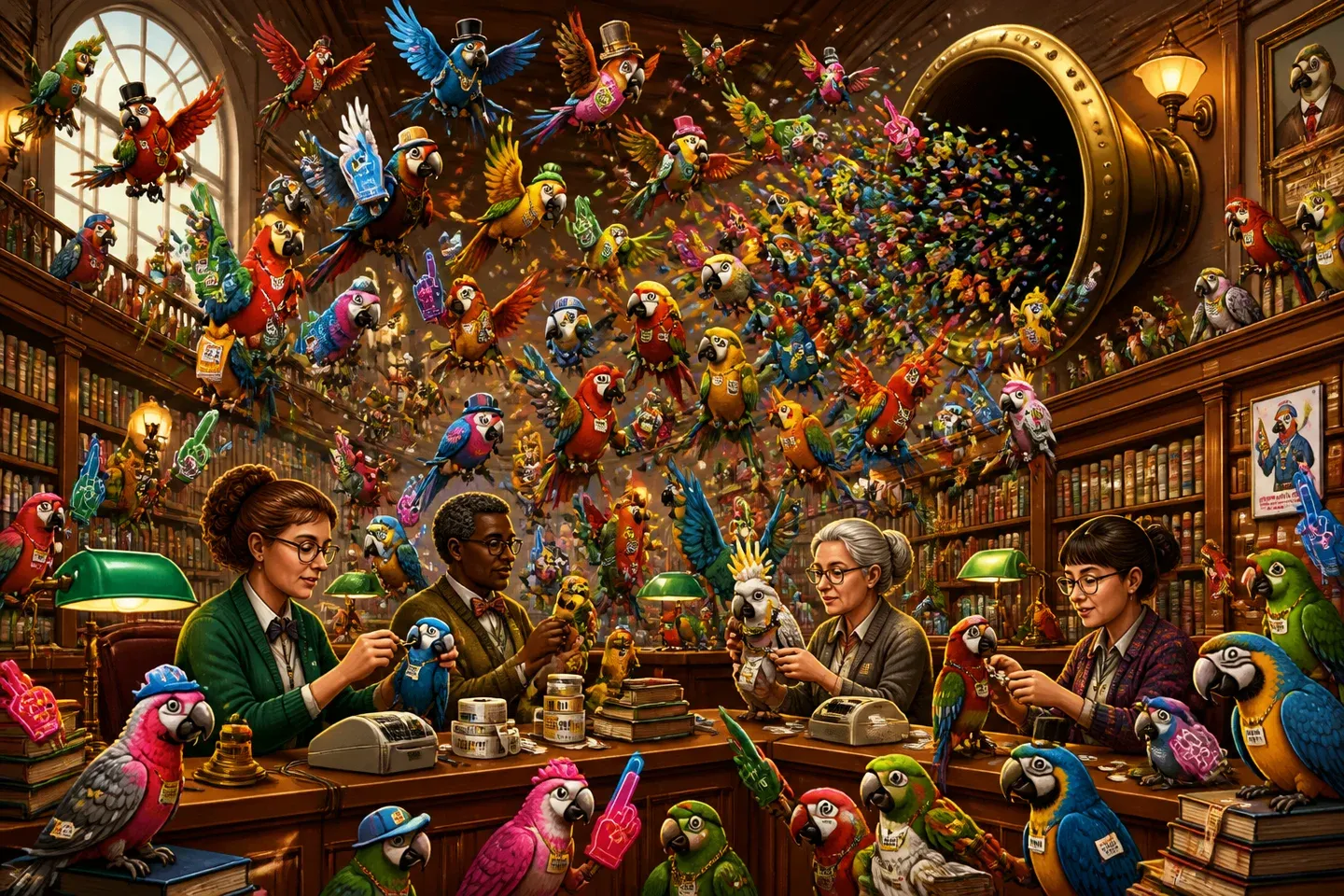
Please return your books by Friday, and also try this mushroom coffee that makes your liver believe in itself.
We don’t need to burn down the library.
We need to label the parrots.