Your AI Future Should Not Be Run by Guys Building Panic Castles
The Robot Apocalypse Has a Business Casual Dress Code

Some of the people racing to build artificial intelligence are also buying remote land, stocking generators, and apparently preparing for the moment civilization becomes a Mad Max reboot sponsored by Nvidia.
Which is a hell of a business plan:
“We have created a machine that may destabilize jobs, truth, elections, and security. Anyway, good luck out there! The emergency entrance to my volcano compound is behind the waterfall.”
A bunker can hold canned beans, ammunition, and one billionaire’s increasingly haunted face. It cannot run a hospital, repair a power grid, deliver insulin, or explain to 40 million laid-off people why the future was apparently designed as an escape room they weren’t invited into.
And this is the part everyone keeps getting wrong. The scary AI future is not necessarily a robot waking up, looking at humanity, and deciding we are too moist to live.
The scarier version is a perfectly ordinary manager clicking DEPLOY because the software is cheaper than a human being and comes with a dashboard.
AI can do wonderful things. It can help spot disease in scans, translate speech in real time, describe images for blind users, chew through bureaucratic sludge, and maybe free nurses and teachers from the sacred American tradition of filling out forms until death claims them.
Great. Give the nurse an AI assistant.
Do not give the AI assistant the nurse’s job, the patient’s insurance appeal, and a tiny judge wig.
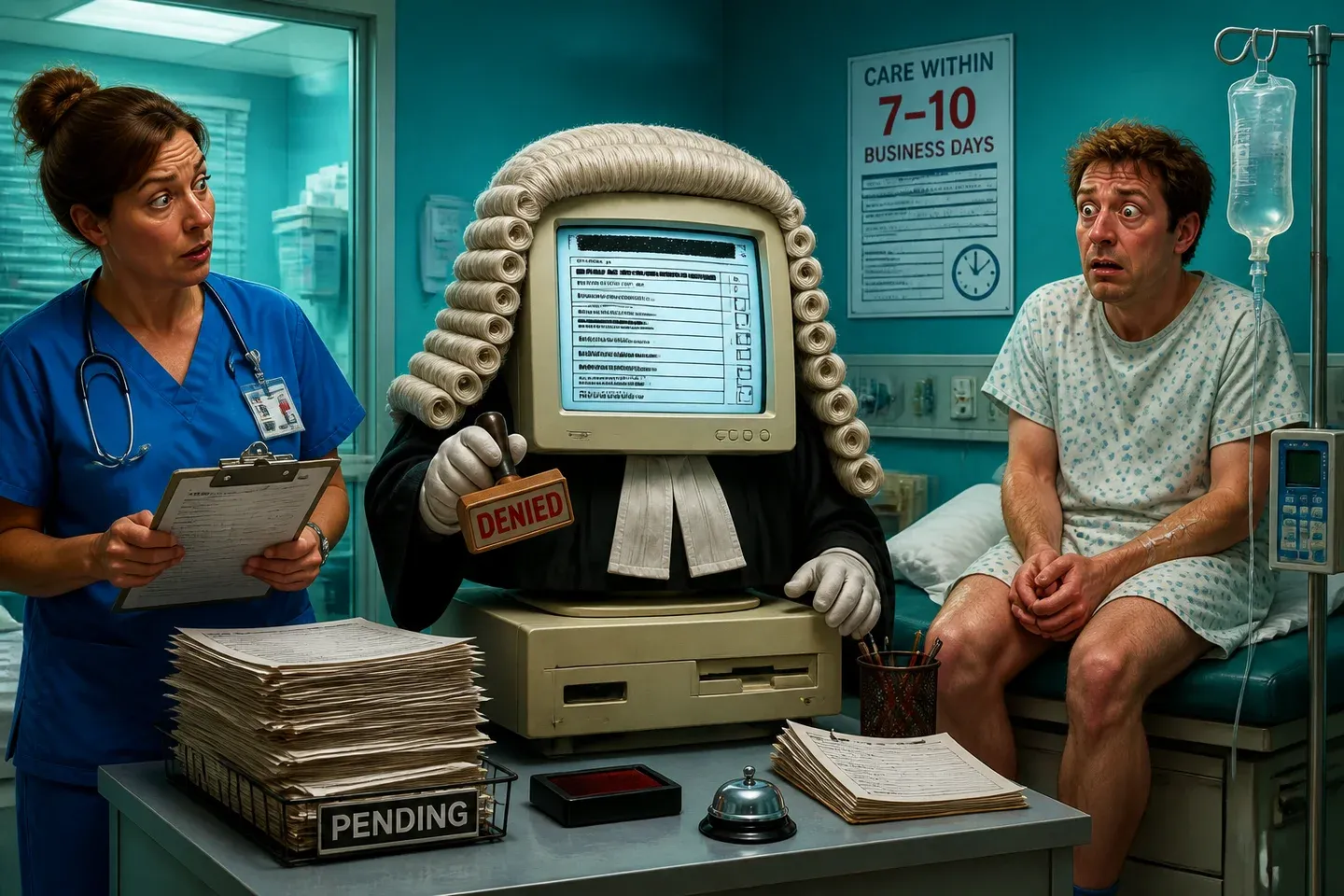
Sure, the software can help with triage. It just shouldn’t be allowed to sentence a pancreas to death by prior authorization.
Because “AI” also means systems that can automate surveillance, scam people at industrial scale, flood the internet with fake voices and fake video, and make hiring decisions with the emotional depth of a vending machine rejecting a dollar bill.
Amazon famously scrapped an experimental recruiting tool after discovering it penalized résumés containing words associated with women, such as “women’s,” because it had been trained on the company’s historically male-dominated hiring data.
The machine did not become sexist because it watched Mad Men.
It learned from humans. Then humans gave it Excel powers.
| What the company calls it | What it can mean for you |
|---|---|
Automated efficiency | A computer rejected your job application and nobody can tell you why |
Risk scoring | An invisible spreadsheet has decided you look suspicious |
Human in the loop | Dave clicked “approve” 900 times before lunch |
Personalization | The scammer now knows your dog’s name and writes better emails than your uncle |
That last one is not theoretical. Generative AI has made phishing, impersonation, and fraud cheaper to produce. The old scam email arrived written like it had been translated through a washing machine. Now it can sound like your boss, your bank, or your panicked grandmother asking why she needs $2,000 in iTunes gift cards.
The robot uprising may begin with a voicemail from “Mom.”
“Human in the Loop” Is Corporate for “Dave Is Tired”
Whenever an algorithm does something horrifying, somebody will assure you there was “a human in the loop.”
Wonderful. Was that human allowed to disagree? Did they understand the machine’s reasoning? Did they have time to inspect it? Or were they one exhausted contractor staring at 600 automated recommendations while a supervisor whispers, “The software is usually right”?
Because those are wildly different loops.
Michigan’s MiDAS automated unemployment system incorrectly accused tens of thousands of people of fraud in the 2010s. People had wages seized, tax refunds intercepted, and lives detonated by a computer system that treated error messages like criminal evidence. The state eventually paid a $20 million settlement in a class-action case.
That is the real nightmare: not a glowing red eye declaring “HUMANS ARE INEFFICIENT,” but a letter saying you owe the government money because a database got confused.
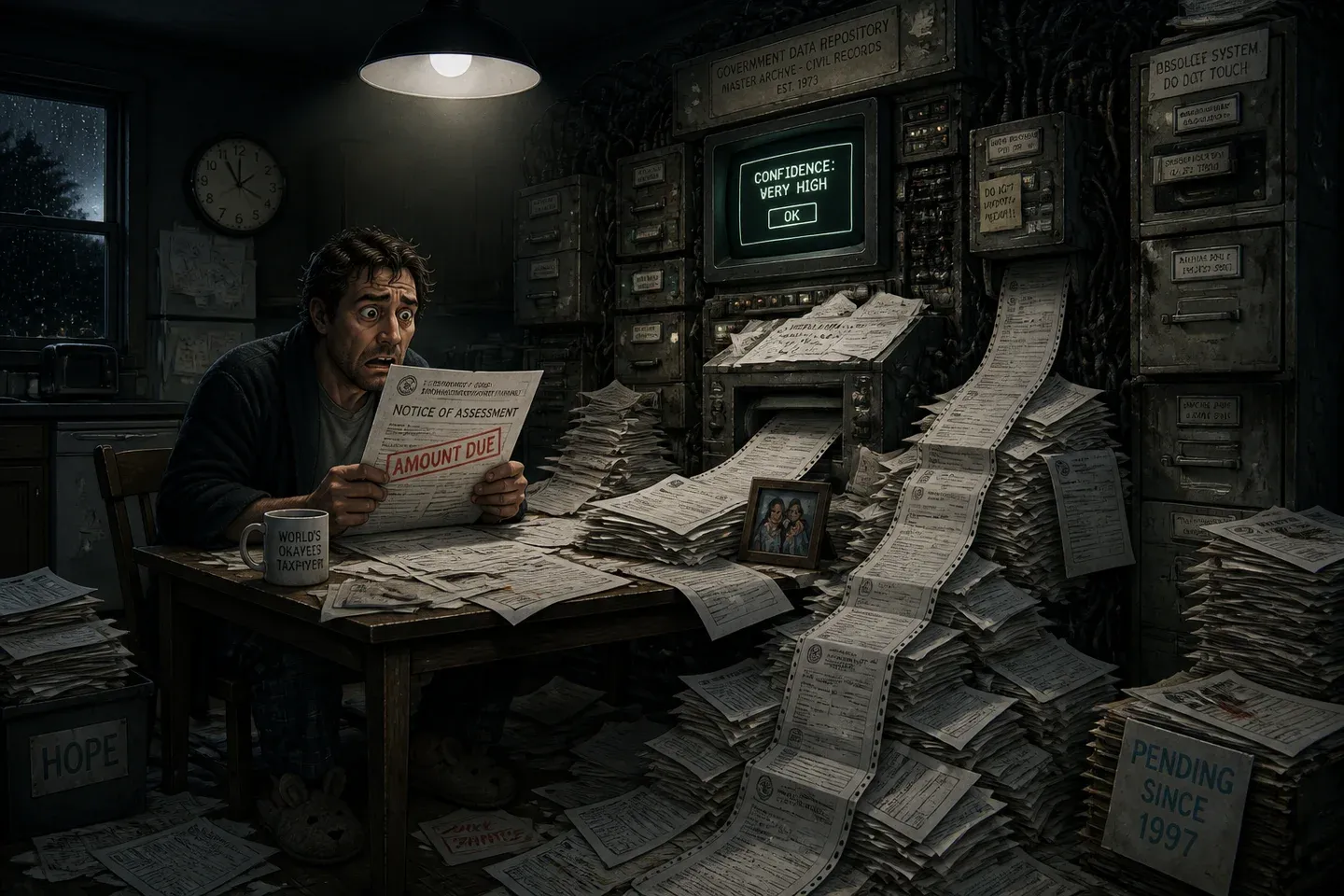
At last, the apocalypse has been optimized for window envelopes and a hold queue with jazz on it.
Robert Williams, a Black man in Detroit, was wrongfully arrested in 2020 after facial-recognition software incorrectly matched him to a shoplifting suspect. Police showed up at his house, arrested him in front of his family, and detained him over a computer’s bad guess.
A system should not get to ruin your day, your job, your credit, or your freedom unless you can do three extremely radical things:
-
Know it was used on you.
-
See why it made the decision.
-
Challenge it before your life gets fed into the paper shredder.
A chatbot saying, “I’m sorry you feel that way about being denied housing” is not an appeal process. That is a hostage negotiator made of autocomplete.
Maybe Don’t Let Five Companies Own the Brain Pipes
The AI race is being sold as a magical explosion of innovation, which is technically true in the same sense that a fireworks factory fire is an explosion of light.
A handful of companies control enormous amounts of the chips, cloud computing, data, and models needed to build advanced AI. So the future of work, education, media, and government is increasingly being rented from firms whose legal duty is not “protect democracy,” but “make line go up.”
Their incentives are not mysterious:
-
Companies want market dominance.
-
Managers want fewer payroll expenses.
-
Governments want military and intelligence advantages.
-
Investors want the kind of growth chart that makes them briefly forget they are mammals.
Nobody in that chain gets a bonus for asking, “What happens to the warehouse worker, teacher, call-center employee, or public-benefits applicant when this goes sideways?”
If AI boosts productivity, terrific. Then people should get something from it besides an invitation to “reskill” for a job that has also been automated. Better pay. Shorter workweeks. Training that is more substantial than a webinar hosted by a cartoon lightbulb. Real bargaining power before a company replaces half its staff with software and calls it “a lean transformation.”
Replacing workers without sharing the gains is not innovation. It is a heist with a TED Talk.
The Off Switch Is Not Anti-Technology
We regulate airplanes because they fly over our houses full of fuel and because “move fast and break things” becomes less charming when the thing is an airport terminal.
AI systems that help draft birthday invitations do not need the same rules as systems that decide who gets a loan, predicts crime, screens job applicants, controls accounts, or helps criminals write malware and biological-research instructions.
That is not banning AI. That is recognizing that a calculator and a flamethrower should not come with the same instruction manual.
High-risk systems need independent testing, security protections, public incident reporting, real audits, and—here is the wild socialist fever dream—an actual ability to pause them when they hurt people.
Not “pause them after the quarterly earnings call.”
Now.
Companies should not be allowed to mark their own homework, hide the answers, and then explain that the homework is proprietary when it accidentally ruins somebody’s life.
The opposite of panic is not shrugging and hoping the billionaires have enough beans. It is building rules sturdy enough that nobody needs a bunker because the rest of society was treated as beta testers.
The future does not need to be predictable.
It just needs an appeal button, an emergency brake, and fewer people whose disaster plan is “I’ll be fine, because I own a helicopter.”

The appeal button is for the rest of us. The helicopter is apparently the executive tier of customer service.